|
Michael McFadyen's Scuba Diving - Sydney's Shipwrecks
While Sydney does not have wreck of the quality of the SS President Coolidge in Vanuatu or the intactness of Chuuk Lagoon, there are almost 30 wrecks located off the coast that are well worth diving. They vary from the scuttled wrecks of Long Reef to the fantastic historic wrecks off Royal National Park. The following is a summary of most of the wrecks of Sydney (as at 2 January 2026).
Unless stated, all the wrecks are boat dives. While many, if not most, of the wrecks are out of the reach of the average diver due to depth and location, you can certainly experience the thrill of the shallower wrecks while gaining experience and training to enable you to dive the deeper wrecks. More than anything, experience in diving will enable you to dive the deeper wrecks.
List is from north to south. Also see for a summary of GPS and marks.
VALIANT
The 23 metres Valiant was a tugboat that originally operated out of Melbourne. It was purchased by a Sydney company but it failed to pass the Maritime Services Board survey. In 1981 after a complicated series of events while under tow be scuttled, the tow ropes broke and the Valiant sank approximately one kilometre east of Barrenjoey Head.
At a depth of 27 metres and sitting upright with a slight list to port, it is basically intact. Quite a good introductory wreck dive.
SS BIRCHGROVE PARK
The SS Birchgrove Park was a coastal collier that sank on 2 August 1956. The 47 metre long wreck is located at a depth of 52 metres. Lying on its port side (why are nearly all the real wrecks of Sydney on their port sides?), the wreck is still fairly intact with the boiler, engine, bridge, funnel, stern, bow and holds easily picked out. A very good dive for experienced deep divers.
THE TRIO
The Trio is a barge about 50 metres long located off Avalon Beach. At a depth of 51 metres it is for experienced deep divers. I have been unable to find out the exact history of the wreck but it appears to have been on a voyage from the north to Sydney. In one of the three holds there is a fair sized ferro
cement yacht. Only worth a couple of dives. If you know anything more, contact me.
SS DUCKENFIELD
On Friday 24 May 1889 the SS Duckenfield, a 251 ton collier ran into Long Reef and later sank. In late 1987 Alan and Neil McLennan rediscovered the wreck in 25 metres of water. The wreck is not very big and the main features are the boiler and engine as well as the hull ribs and a couple of anchors and winches. A very good dive, especially for the less experienced.
SS DEE WHY
One of Sydney’s most famous ferries, the 70 metre long Dee Why was scuttled as the first wreck at the Long Reef Wreck Site on 25 May 1976. Although now beginning to show its age (almost 100 years), the old ferry is a tragic site lying on the 46 metres deep sandy floor. You can still explore inside the wreck, between the boilers but the engines and props are gone. A great dive.
SS BELLUBERA
Built in Sydney in 1910, the Bellubera was 70 metres long and almost identical in size to the Dee Why. On 1 August 1980 the old Manly Ferry was scuttled to the east of her Harbour partner. I have not dived the wreck much it is now in two parts. A good dive, although not too many people dive it.
COOLOOLI
One of the largest vessels scuttled on the Long Reef Wreck Site is the bucket dredge Coolooli. She displaced 150 tonnes and was 50 metres long and 10 or 11 metres wide. In August 1980, the Coolooli was sunk as part of the reef and now lies on its starboard side on sand in 48 metres of water. This was an
excellent deep dive but has collapsed heaps in the 2000s, suited to less experienced deep divers as the shallowest part sticks up to about 36 metres (well it used to). It is bigger than its dimensions describe, and takes numerous dives to fully appreciate its many features. Has collapsed badly in June 2009. Well worth diving.
HIMMA
Also scuttled in 1980, the large 34 metre long tug Himma now lies at 48 metres, although you can reach 52 metres swimming through a hole in her hull. A tragic wreck that claimed the lives of two divers in October 1991, it was stripped of everything but the prop before it was sunk. Only worth two or three dives and thence once few years.
MEGGOL (ex HMAS Doomba
and HMS Wexford)
Built as HMS Wexford in about 1917 or 1918 it served with the Royal Navy until December 1921 when moved to Brisbane where it was renamed the Doomba. During WW2 it served as HMAS Doomba. After this it was converted into a refuelling tanker and renamed the Meggol.
Scuttled in December 1976 only 20 metres from the Dee Why, the Meggol was 70 metres long and today it sits upright on a sandy bottom of 49 metres. Rusting through quite badly, the deck is 43 metres down. The vessel is basically intact but it is a mess. Worth a couple of dives now and again.
SS MYOLA
Sydney’s newest wreck dive location, the Myola sank in 1919 only six weeks after the SS Undola. At a depth of about 50 metres, the once pristine wreck has been
plundered badly since it became known to the diving public in January 1995. Despite this, it is an excellent dive. The two boilers, engine, stern section and bow area are especially interesting. Many dives on this wreck are required to fully appreciate the wreck.
CENTURION
The Centurion wreck is located just off Quarantine Point in Sydney Harbour. The remains are in 18 metres of water on a sandy bottom. Twisted iron, masts, timber and some other pieces of the ship can still be found although it looks nothing like the 63 metre sailing vessel it was. While the actual wreck site is not very large and can be explored in 15 minutes or so, the wreck has attracted a lot of fish life which greatly adds to the quality of the dive. This dive can be a very enjoyable night dive.
ITATA
The Itata wreck is located up Middle Harbour and was only ever dived for training dives as it is very dirty (that's why they dive it for nil visibility).
SS CENTENNIAL
The Centennial is located in Taylors Bay on the northern side of the Harbour. Built as the SS Albion in Greenock, Glasgow, Scotland, in 1863, she was 66 metres long and displaced 668 tons. A passenger and cargo vessel, the Centennial was a regular sight on the Sydney/New Zealand run. On 23 August 1889, the Centennial arrived in Sydney and quickly took on a load of 52 passengers and wool before leaving for Wellington, New Zealand at 8.45pm. As she approached Bradleys Head, the collier SS Kanahooka collided with her and she sank. A fairly limited dive that I have dived only once.
TSS CURRAJONG
Just off Bradleys Head is the wreck of the TSS Currajong, probably NSW’s most intact shipwreck. Technically illegally to dive, extreme care must be taken as many hundreds of boats can pass this spot in an hour on a fine summer weekend. From the shore it is 200 metres out to the wreck which lies from 18 to 26 metres.
The 70 metre long Currajong was rammed by the Wyreema on 8 March 1910 and sank very quickly. Today it is a great shore dive, albeit a very dangerous one.
SS ROYAL SHEPHERD
The Royal Shepherd is located just outside Sydney Heads and therefore visibility is not always the best. The site is not very big but there is the boiler, engine, driveshaft and propeller. A good introductory wreck or deeper dive. Maximum depth of 27 metres.
On Monday 14 July 1890 at 9.35 pm, the Royal Shepherd left Sydney Harbour for Bulli to load coal under the command of Captain Thomas Hunter. An interesting point is that Captain Hunter was the skipper of the SS Duckenfield which sank less than 14 months earlier in May 1889 only a few kilometres north of the Harbour at Long Reef.
DUNBAR
There is not much left of the 1321 ton Dunbar but still can be an interesting dive. Located near The Gap at South Head. You will have to look under every boulder. Very shallow so it means that you must have flat seas. Sank on 21 August 1858. Today, the remains of the Dunbar can be found just below the signal station at South Head. The depth is only 4 to 7 metres.
SS ANNIE M. MILLER
Although built for use as a collier, she was primarily used to carry blue metal from Shellharbour to Sydney. Only six months after being launched and less than three months after taking up service, the SS Annie M. Miller sank just north of Bondi Beach. Today the wreck lies at about 45 metres and is a very interesting dive for the experienced deep diver. Well worth many dives.
TSS BELBOWRIE
The wreck of the TSS Belbowrie can be found at South Maroubra about 200 metres from the beach just off the rock platform. It sank here on 16 January 1939 and the timber ship was quickly broken up by the seas. Today the remains of engines, winches and other bits can be found in the shallows. A hard shore dive but worth the effort.
SS TEKAPO
One of the larger vessels to strike the New South Wales coastline is the Union Steam Ship Co. of NZ ship, SS Tekapo. She sank in 1899 when it ran aground in calm seas on the way to Port Kembla to take on coal. Today the remains lie almost right at the end of the point to the south of Maroubra Beach. A boat dive except if you are of extreme fitness. Not much left now.
GOOLGWAI
Located adjacent to Yellow Rock and just to the east of the Malabar is the wreck of the Goolgwai. The Goolgwai was wrecked on Boori Point, Long Bay, on 29 May, 1955. A trawler used in WWII as HMAS Goolgwai, the wreck today does not really consist of much except perhaps the prop.
MV MALABAR
A great shallow (9 metres) wreck dive that can be done from shore. It is a long walk out to the site, so a boat is better. A huge diesel engine, driveshaft, prop, rudder, anchor and other bits make this an interesting dive. Heaps of huge blackfish and bream inhabit the engine. A very important wreck site as it was the first motor vessel on the East Coast of Australia and gave its name to the suburb where it was wrecked. 2 April 1931.
SS KELLOE
An excellent deep dive with a maximum 52 metres. The boiler and engine are intact but the rest is broken up. The prop is partially visible as is the rudder and hull remains. A couple of anchors and winches make the wreck interesting. Only for the experienced deep diver. Sank on 13 May 1902 after a collision with the SS Dunmore.
SS MINMI
The remains of wreck of the SS Minmi lie just inside the northern headland of Botany Bay and some parts reputedly lie outside the bay next to the rock platform. A possible shore dive but a long walk. Need calm seas to do outside bay but excellent in northerly seas inside. Less than 10 metres. The 80 metre long collier ran aground on 13 May, 1937 with the loss of two lives.
SS WONIORA
A very deep wreck (60 plus metres?) that I have dived only once. Not very big, but it is very good. Only for the very, very experienced deep diver. Also very limited access now as in the middle of the channel into Botany Bay and so many ships now come in and out.
SS HILDA
The Hilda is a very good wreck dive for the advanced diver. The engine still remains along with the prop, rudder, anchors, parts of the boiler and other pieces. Worth diving every few years. The hundredth anniversary of the sinking of one of Sydney's lesser known shipwrecks occurred on 20 July 1993. The
ship, sometimes disparagingly called the “Clayton's Wreck”, is the SS Hilda.
 |
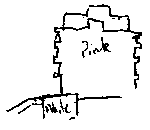 |
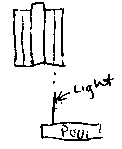
| Eastern Mark |
Northern Mark |
| Wollomstrom Marks |
WOLLOMSTROM
A small tug that sank in about 1970 in Gunnamatta Bay right opposite the baths. Very dirty and in less than 10 metres of water the hull is fully intact. A real desperate dive.
SS TUGGERAH
At 48 metres, this is only for the experienced deep diver. The "Tug" is always covered in nannygai as well as carpeted with wobbegongs. Lying on its port side, the wreck itself is still very in good condition after well over 100 years down. The rear section is in one piece with the twin boilers, engine, prop, rudder, funnel all in place. Affected by current on many days, care must be taken. Often gets visibility of more than 30 metres.
SS UNDOLA
A bit shallower (45 metres) and smaller than the Tuggerah, the Undola is almost as interesting and an excellent dive. The boiler and engine are intact as is the stern and bow. It is famous for its
toilet still sitting upright but out in the open. Also over 100 years old now.
| 



 v6.00.307 © 2003-2005


