|
Michael McFadyen's Scuba Diving - Bellubera Ferry
Another of the ships scuttled at the Long Reef Wreck Site off northern Sydney is the former Manly Ferry Bellubera. Like the Dee Why, the Bellubera was a double ended ferry built for the Port Jackson and Manly Steamship Company for the Manly run.
On 26 April 1910, the Bellubera was launched at Mort's Dock, Woolwich, Sydney, the largest and fastest Manly Ferry built to date. She was 210 feet (63 metres) long and 32 (9.75 metres) feet wide with a gross tonnage of 499 tons. Two boilers provided steam for the two triple expansion engines which drove the single props at either end of the ferry.
Carrying 1,529 passengers, it did not take too long for the Bellubera to achieve its reputation as a hoodoo ship.
On 10 May 1910, soon after being launched and while been fitted out, chains holding one of the 40 ton boilers broke and it fell into the hull causing considerable damage.
 | 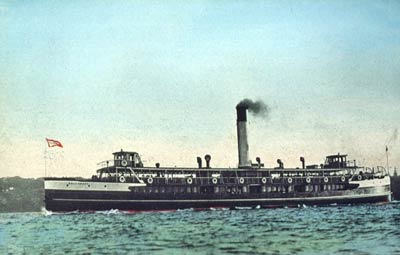 |
| The Bellubera's launch | SS Bellubera, as built, a steamship |
The next trouble the Bellubera got into was off Dobroyd Head (opposite The Heads) on 2 April 1914 when she cut in half the Kate, a tug which was towing a lighter. It was lucky that the lighter was not hit as it was carrying a considerable amount of high explosives. The Bellubera was not damaged. The next 21 years appear to have been fairly uneventful.
The steam powered ferries were expensive and inconvenient to operate. For this reason, it was decided to convert the Bellubera to diesel electric power. In September 1935 after just over 25 years service, the Bellubera went into have her steam engines removed and be converted to diesel-electric. The Bellubera was only the second British vessel (note this anachronism) to be so converted. After the steam engines and boilers were removed, the Bellubera had four Harland & Wolff five cylinder two-stroke diesel engines of 450 bhp installed. These drove direct-current generators which supplied electric current to four electric-propulsion motors of 615 hp each. Two 85 bhp diesel engines were installed to power the generating plant for lighting and auxiliary power. It is possible that at the same time some hull plates were replaced. I have also been told that at the same time the seats were recovered with leather and the woodwork revarnished.
On 28 June 1936, the Bellubera returned to service but from then on the hoodoo really got worse. Sometime after this an engineer cut his finger on a section of the engine. Within two weeks he was dead from blood poisoning. On 16 November 1936 while at the Kurraba Point ferry yards, a fire started on board the Bellubera when sparks from an oxy torch fell onto a seat and burst into flames. Five men were trapped inside the ship for nearly an hour until the fire was extinguished. The Bellubera was a burnt out shell with damage estimated at £40,000. Worse still, two men, Robert Findlay, 38, fitter and Sidney Tight, 44, greaser, died as a result of the fire. Two other men were injured, including one who spent almost two years in hospital.
In October 1937 the Bellubera was returned to service after extensive repairs at the Cockatoo Island dockyard. The diesel engines were overhauled but not replaced. The engines gave trouble after that time and later they were to be replaced with four high speed supercharged GM five cylinder diesel engines. Normally only three ran at a time, but at times she operated on only two engines. This appears to have been sometime around the early 1940s (this comment about later engine replacement is from Harold Roy, engineer on the ferry).
Quote from Harold Roy:
Bellubera was a bit of a cough drop and took an amount of effort to keep her in service. Also she was so noisy that on today's standards she would have been black banned and tied up for good. It was she that was blamed for leading the Japanese submarines through the harbour boom in the war, and I blame her for my hearing difficulties. Nevertheless even with the hard work, I don't think I would have given her away for any of the steamers. She was a happy ship.
On the night of 9 September 1941 during heavy rain, Sidney Rose, 54, died when the Bellubera ran down the 30 ft Sydbridge off the current site of the Opera House.
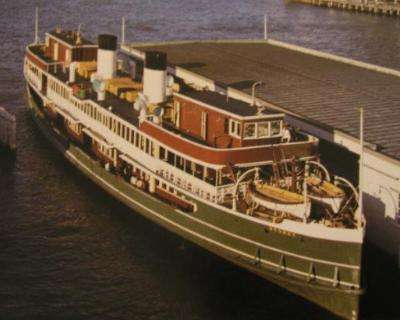 | 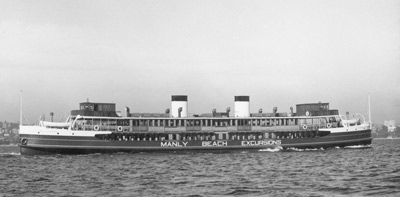 |
| The Bellubera at Circular Quay | The Bellubera on the harbour |
The next incident occurred on 6 February 1945 as the Bellubera approached the Heads when Captain Wally Dohrn (Snr) collapsed and died of a heart attack. In September of the same year, a young woman, apparently feeling seasick, leaned too far over the railing and fell overboard. Luckily, two soldiers saw what happened and they dived in and rescued her.
Soon after this incident, a young man leaped over the side of the Bellubera shouting that he wanted to die. The Bellubera turned around and lowered a boat which dragged him (fighting) back to safety. The Bellubera's horror year continued when on 31 January 1946 a man fell from the top deck of the ferry as it passed Clifton Gardens. He drowned.
The strangest story about the Bellubera happened on the night of 17 August 1948 when she was near the spot where Captain Dohrn died. Passengers heard loud moans coming from the water. Searchlights were used to comb the water but nothing was seen and no-one was missing. It is reported (the Australian Government Environment Web Site) that on 19 October 1948 she was in a serious collision near Sydney Heads. However, I have not been able to confirm this report. I believe that this report is incorrect and it is an error of dates. See the report two paragraphs below about a collision near Bradleys Head on 18 October 1950 (notice the similarity of dates).
 | 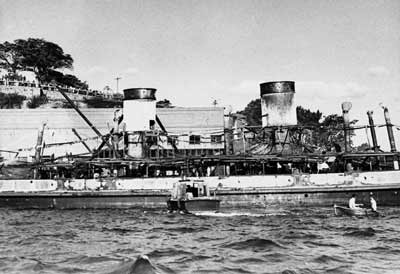 |
| The Bellubera is still on fire, 1936 | You can see how badly the Bellubera was damaged |
On 16 August 1949 a Navy stoker fell from the Bellubera. Fifteen minutes later in the pitch black darkness, passengers on the Dee Why heard shouts from the water. The ferry stopped and the lucky man was saved.
As if all this was not enough, just over a year later on Wednesday 18 October 1950 the Bellubera collided with the 7,000 ton Norwegian freighter Taurus off Bradleys Head. The ferry was under the command of Captain Frederick Ernest Tocchini and had left Manly with about 100 passengers on board. The Taurus was coming from Melbourne with pilot Captain John Neville Collins in command. There was a light drizzle.
Both vessels were coming up the Harbour when they collided. They were both in the western channel (the incoming channel) heading towards the Bridge. The Taurus was closer to Bradleys head and doing about 12 knots to the Bellubera's 10 to 12 knots. Thus, the Taurus was overtaking the ferry (it should be noted that most ships did only 8 knots up the Harbour).
 | 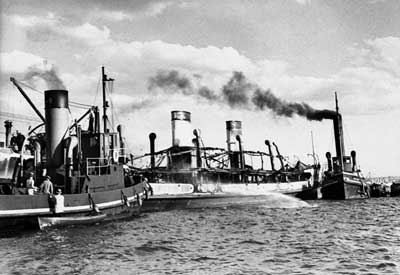 |
| A close up of the Bellubera | Two tugs fighting the fire, but it is too late |
As they rounded Bradleys Head, the Bellubera turned to the right to head up the Harbour. This is totally legal and is how the channel changes direction. However, the pilot appears to have decided to leave the channel and keep the Taurus heading straight ahead towards her berth at Woolloolmooloo.
The Taurus should have given way as it was the overtaking vessel. It blew two blasts from its horn but it was too late, the Taurus ploughed into the starboard side of the Bellubera. It seems that the ferry was almost rolled over, going so far over on her port side that water entered the hull through the doorways. Fifteen feet of the ferry's lower deck was smashed. People were thrown from their seats. Harold Roy also stated that there was damage to the steering gear and (stern) prop. Five feet of the Taurus's bow was bent and a hole about 18 inches wide was ripped on the starboard side of the hull. Some hull plates were also buckled.
The Bellubera was also spun around 180º. Harold Roy advised Captain Tocchini that the other end of the ferry (remember all the Sydney Harbour ferries have always been "double ended") was okay so it proceeded to Circular Quay under its own power. Apparently back at the Quay, a journalist come down into the engine room of the ferry and attempted to ask questions of "the engineer". Harold Roy threatened to hit him with a large spanner and he departed!
The Bellubera was left at Circular Quay. Harold Roy and his "greaser" Georges Capdeville were then taken by taxi to the laid up SS Balgowlah and had to get steam up so it could be used to replace the Bellubera for the next day's runs to and from Manly. This took them till 5:30 am.
A preliminary inquiry into the collision was announced to be held at 2.30 pm on Monday 23 October 1950 in camera. The Harbourmaster for Sydney Harbour, Captain F. Murchison said that this inquiry would depend whether the matter was taken further. It seems that this inquiry might not have been held.
A Commonwealth Court of marine inquiry started on Tuesday 14 November 1950. It was to investigate the cause of the collision. Canberra Supreme Court Judge, Mr. Justice W. B. Simpson, presided. The Court sat in the No. 1 Workers' Compensation Court, 60-66, Hunter Street, Sydney.
Evidence at the inquiry was as the above paragraphs. However, on Tuesday 12 December 1950, Justice Simpson suspended for six months the certificate
of Captain Frederick Ernest Tocchini, who was master of the Manly ferry Bellubera when it and the Taurus collided. Justice Simpson found
that the collision was caused by an act or default amounting to misconduct on the part of Captain Tocchini. The master of the Taurus Captain Thoranf Wennberg, and Captain John Neville Collins, who was piloting the Taurus.
He said he had no power to deal with Wennberg's licence
An appeal by the master of the Bellubera Captain Frederick Ernest Toechini, against the suspension of his certificate for six months by the Commonwealth Court of Marine Inquiry was upheld by Mr. Justice Maxwell, sitting in Admiralty jurisdiction in the Supreme Court on Wednesday 29 August 1951.
In a reserved judgment Mr Justice Maxwell said he accepted the Marine Court's
findings of fact, but was unable to accept its conclusions. Mr Justice Maxwell said it
had been argued that there was an obligation on Captain Tocchini to look astern before making a turn to starboard which, in a sense, contributed to the collision. EH said "There is neither a specific article nor any rule of good seamanship which required this on the part of the master,"
His Honor held "lt cannot be too strongly stressed that, in waters where the ferry found herself, the master was bound reasonably to make himself aware of what was going on around him. But the facts as found by the Court of first instance fall far short of establishing any breach in this respect by the ferry master, or of any responsibility in a material sense for the casualty. "On the findings of the
Court of Marine Inquiry the appellant had no reason to apprehend danger from the
Taurus."
It was to be five years before the Bellubera made news again but first it was to be re-engined. In February 1954 the Bellubera went to the State Dockyard at Newcastle and had three English Electric diesel engines installed to replace the four old engines. On 21 October 1954 she returned to service and continued for another 19 years using these engines.
On the night of 20 August 1955 a man fell off the Bellubera but this was not reported to the crew until she docked at Manly. The ferry quickly returned to where the passenger said the man would be and there they found him swimming. He was handed over to the Police.
Off Fort Denison on 27 February 1958 a woman fell overboard. The Water Police found her completely submerged. She recovered.
At about 10.15 pm on 25 June 1960, the Bellubera stuck an object, believed to be a log, at The Heads, which buckled the rudder and fouled the prop. The engines stopped and she began to drift towards Dobroyd Head and then Manly Point. Finally after 35 minutes the anchor took hold saving her from further damage.
On 14 October 1960 a man jumped off her near Middle Head. He was found some time later by the collier SS Mortlake Bank clinging to a channel marker.
The next year another skipper of the Bellubera died at the wheel. On 3 February 1961 Albert Villiers collapsed and died of a heart attack while berthing the ferry for refuelling. Later the same year on 13 December she broke down near The Heads and she was towed into Watsons Bay after nearly hitting the rocks below Middle Head.
 | 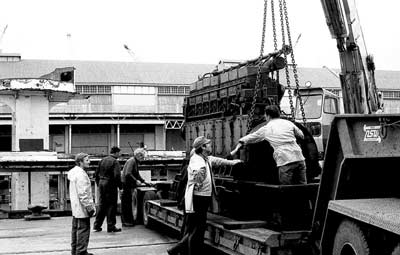 |
One engine is lifted out of the Bellubera
Photo by Stuart McPherson | The engine is placed on a semi-trailer
Photo by Stuart McPherson |
Another decade was to pass before the Bellubera's last incident. On 28 February 1970 she rammed the anti-submarine destroyer HMAS Parramatta while the warship was refuelling off Clifton Gardens and tore a hole 6 ft by 8 ft in the warship's side. The Bellubera was also damaged but I am not sure of the extent of this damage.
After 63 years faithful, if somewhat dangerous service to Sydney, the Bellubera made its last run to Manly on 29 November 1973 (or 29 October if other records are to be believed).
By my reckoning, the Bellubera had collided with at least four (possibly five) vessels, sinking two of them, seven persons had died through direct association with the ferry and at least seven people had fell or jumped off the ferry in mid-Harbour.
 |  |
The hulk of the Bellubera is really showing its age here
Photo by Stuart McPherson | Two of the engines can be seen here just before they are removed
Photo by Stuart McPherson |
After lying on the Harbour for almost seven years, the Bellubera was scuttled off Long Reef as part of the artificial reef on 1 August 1980. Stuart McPherson contacted me and told me that as a teenager with a camera and an interest in Manly Ferries, he was around quite a lot as this vessel was being broken up in Cockle Bay in the first half of 1980. The following is an almost verbatim report of what he told me.
The Bellubera almost managed to kill one more person as she was being broken up. The vessel had been purchased by a company named "Trouble Shooter", run by a Dutchman called Jensen. He had purchased her so certain equipment could be stripped from her and installed into an ex-RAN minesweeper, the former HMAS Gull. The Gull (renamed Trouble Shooter, with its hull painted bright yellow) was to become a rescue vessel of some sort, but at the time was a hull in the water with no engines.
 | 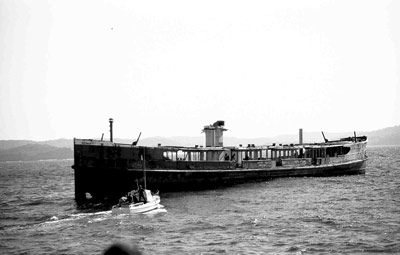 |
The Bellubera is on her way to her final resting place
Photo by Stuart McPherson | The Bellubera is almost in place for the scuttling
Photo by Stuart McPherson |
Stuart advises me that in the end, Bellubera's English Electric diesels were removed and provided to the Public Transport Commission to help keep the North Head and Baragoola in service. In exchange, Trouble Shooter was given a pair of engines (presumably by the PTC) for installation into the minesweeper.
What subsequently became of this minesweeper is not known, but during 1980 it sat in Cockle Bay next to Bellubera, and across the bay from the SS South Steyne which was at that time also in a neglected state.
Stuart says that part way into the stripping of the vessel, large sections of the teak decking were removed whole. The steel deck stringers were cut with an oxy, and then an entire section of decking lifted out by crane in one piece (presumably for sale). It was a faster way of removing the decking timber, because the company had a deadline from the Maritime Services Board (1 August 1980) for the hull to be scuttled. Things were done in a hurry. (Stuart tells me that he has none of the decking timber, but did obtain a pair of the distinctive padded upper-deck benches, which currently live in his garage.)
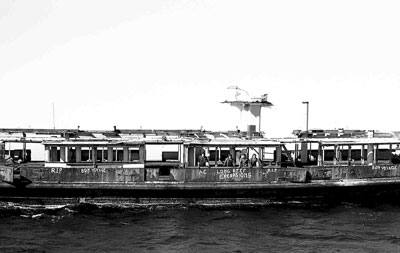 |  |
A close up of the Bellubera as she is towed out to sea
Photo by Stuart McPherson | The Bellubera is still afloat but not for long
Photo by Stuart McPherson |
One of these sections was removed at the bottom of the after stairway. Directly below this lay the gearbox for two electric motors to drive the aft propellor. This gearbox (a large piece of equipment) had also been lifted out of the hull, leaving a number of large threaded rods in rows sticking up vertically (it was these that "bolted" the gearbox to the hull). One wet day Stuart arrived at the wharf. The guys from Trouble Shooter were gathered around and the mood was gloomy. Apparently he had just missed the ambulance. One of the employees had skidded down the wet stairway and gone straight through the big hole where the decking used to be. He landed on the bed where the gearbox used to be, right between two rows of these tall threaded rods. Had he landed slightly to the right or the left, he would have been impaled.
Stuart managed to score a ride on a privately-owned cruiser when she was towed out the heads and scuttled on 1 August 1980. Fortunately, following some time in hospital the injured man was intact enough to ride on the same boat as Stuart and watch Bellubera sink. Stuart forgets his name, but he appears in one or two of his photos of the day. He remembers him being particularly glad to see her go down.
Stuart also reports that the Bellubera went down completely level, unlike the Dee Why which had her bow (or stern?) stuck high in the air.
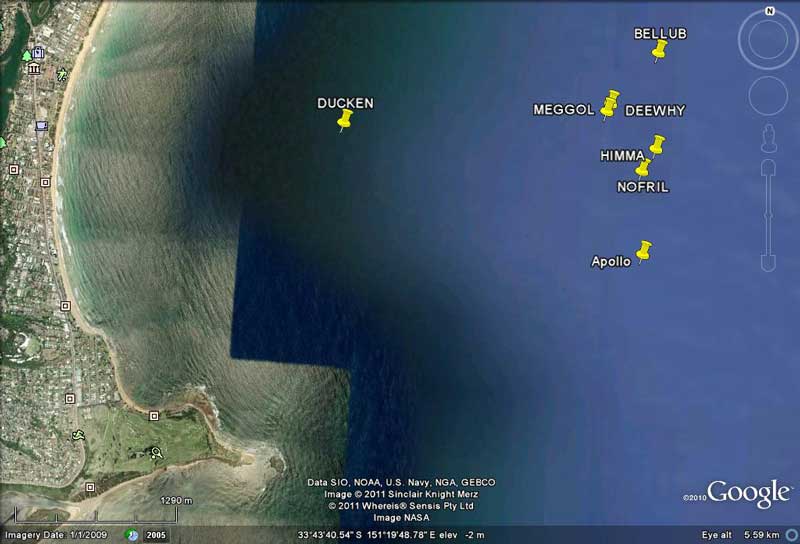 |
A satellite photograph of the coast north east of Long Reef showing the location of the scuttled wrecks
The MV Bellubera is clearly identified |
The ship appears to have broken into two parts when she sank. The GPS reading for the main section of the Bellubera is 33° 42.7051' S 151° 21.0686' E. Note that this GPS Reading uses WGS84 as the map datum. If you use another datum you may be about 220 metres off the wreck.
See my GPS Page for more details and how to convert readings. Marks for the wreck are to have the vertical section of Bangally Point (to the north) just intersecting with the ridge on the northern side of Broken Bay. The eastern mark is the Bahai Temple lined up exactly between two houses on the ridge about one third of the way to the water. Also, there are two large towers (light towers at a sports field I think) close to the water. Take the distance from the left tower to the right one and then place the right one about the same distance to the left of the Bahai Temple. The wreck comes up from about 46 metres to 42 metres or so. The wreck lies east-west. This will put you over the eastern end of the wreck.
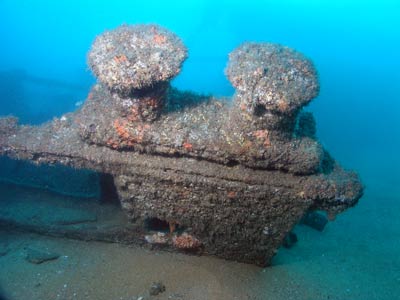 |  |
| One set of bollards on the eastern section of the wreck | Andreas Thimm entering the broken end of the eastern section of the wreck |
On 31 August 2002 I finally got to dive this wreck. The ship lies on its side in about 45 or 46 metres. The bow section here (remember that there were two bows - this is the eastern bow) is very intact. The wreck here comes up to 41 or 42 metres on the top of the bow. You can see the rudder as well as where the prop used to be. On the top of the bow you can see the rudder assembly. You can enter the wreck and it is an interesting explore. There is a broken toilet here. This section of the wreck has a huge number of nannygai as well as some huge Sergeant Bakers (we saw one eating a nannygai).
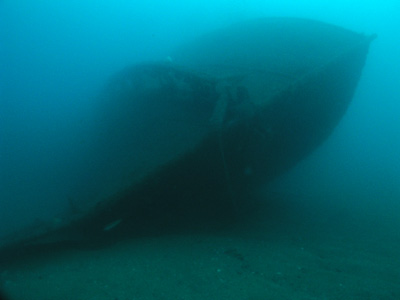 |
| The eastern bow of the Bellubera |
About 15 metres along the hull is broken and the upper part has fallen to the southern side. Past here the wreck is more intact again. The next 20 metres of the wreck has some places to explore. Then the wreck comes to an end. The hull on either side is very twisted, and it appears to me that the ship broke into two when she was scuttled. The other section is apparently 30 metres or so away and used to be connected by a rope. I have not yet examined this section.
Not a bad dive, fairly easy with some simple penetrations. Visibility on my two dives so far has been between seven and fifteen metres or so.
References:
Manly Ferries of Sydney Harbour by Tom Mead
Personal comments by Stuart McPherson to Michael McFadyen in 2000s and 2012
Photos provided by Stuart McPherson
Sydney Morning Herald - 19, 20, 24 October 1950, 4, 11, 15 16, 17, 18, 21, 22, 24, 25 November 1950, 13 December 1950 and 30 August 1951
Emails from Tricia Norman - norman.tricia@iinet.net.au - dated 23 and 24 June 2011
| 



 v6.00.307 © 2003-2005


