|
Michael McFadyen's Scuba Diving - SS Undola
The SS Undola was a sixty miler collier designed by William Sinclair of J. Wildridge and Sinclair Ltd, Sydney. Originally, she was designed for E. Vickery and Sons Ltd which owned the Coal Cliff coal mine. However, in April 1909 the ownership of the coal mine changed to Coal Cliff Collieries Ltd, the majority shareholder of which was E. Vickery and Sons Ltd. Therefore the plans for the new ship were taken over by the new company and in May 1909 an order was placed for the construction of the new ship by J. Fullerton and Co., Paisley, Scotland. The contract cost of the vessel was £7,675, paid in five equal installments of £1,535.
The ship had a triple expansion coal powered steam engine with a rating of 580 hp. The front hold of the collier held 160 tons of coal and the second hold 260 tons. There was a mast between the two holds and this held the coal handling grabs. The Undola was specially built for the Coal Cliff wharf where it was expected to mainly operate from. The new design had a quite shallow draught and also had self-trimming hatches to minimise time spent at the wharf. Of note is the fact that the ship did not have electric lighting as the owners decided that the cost of £225 was excessive. This new ship had something in common with the RMS Titanic, think about it while you are reading the article and the answer is at the end of the page.
The original plan was for the new ship to be named SS Hilda after the collier that sank 13 years earlier off Cape Baily on Sydney's southern edge. Instead, it was named SS Undola, presumably after the locality in the southern section of Royal National Park, when the British Board of Trade declined to register the name Hilda.
The ship was launched on 13 October 1909 (one source says November, but this may be when it was handed over to the owners). The Undola displaced 429 tons and had a length of 41 metres and was 8 metres wide. On about 13 November 1909, the Undola left Scotland under the command of Captain James Leslie.
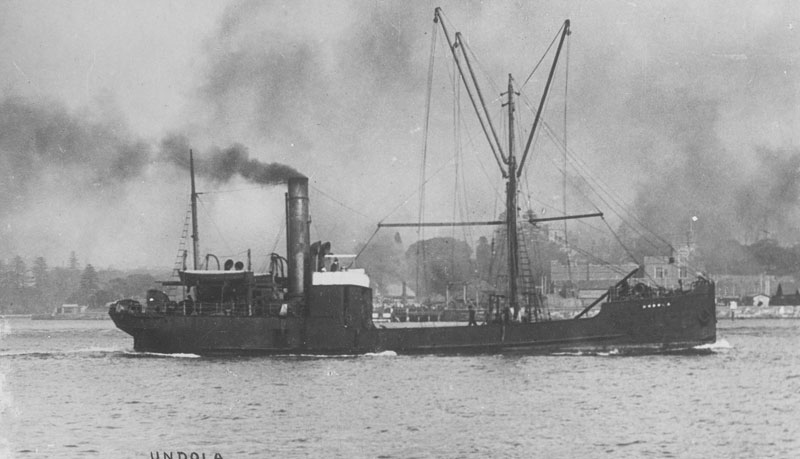 |
| A photo of the Undola coming up Sydney Harbour |
She arrived in Fremantle (western Australia) on Thursday 13 January 1910. She arrived in Sydney on 26 January 1910 after a voyage of 74 days. The cost of the delivery voyage was £1,365. On arriving in Sydney she was given a quick overhaul at Grants Wharf, Pyrmont, had her coal handling equipment installed and was dry docked at Morts Dock where her hull was scraped and painted. In late February 1910 she entered service on the southern coalfield run. Virtually all her career was spent on this run but in her later years she made a few runs to the Newcastle coalfields.
Although owned by Coal Cliff Collieries Ltd, the Undola carried coal for an organisation called "The Southern Coal Owners' Agency" for a great deal of her life. From when she entered service in February 1910 till June 1915 the ship was hired by the organisation for certain trips and payment was on the basis of the tonnage carried. From July 1915, the arrangement changed to one where the ship was chartered to the organisation for £150 per month.
The Coal Cliff wharf was used by the Undola only till 1911 when it was closed. Despite the fact the ship was especially designed for the wharf, she continually hit bottom while loading and sometimes had to abandon loading altogether. For this reason, the wharf was closed and the mine sent its coal to Sydney by the railway. She then operated out of the other wharves on the southern coalfields, presumably including Bulli, Wollongong, Port Kembla and Bellambi.
During her first five full years of operation, the Undola was heavily used. The annual carrying capacity of the ship was 63,200 tons of coal and the attached table shows her usage. This indicates that even though the ship was often subjected to poor sea conditions, it was still heavily used. Note also the profit (or lack of) made by the ship.
| Financial Year Ending 31 March | 1910/11 | 1911/12 | 1912/13 | 1913/14 | 1914/15 |
| Coal Carried - Tons | 46,382 | 45,226 | 48,348 | 44,459 | 46,830 |
| Percentage of capacity | 73.4% | 71.6% | 76.5% | 70.4% | 74.2% |
Despite this, the ship only turned a profit in 1912/13 (£304) and lost a total of £2,159 in the other years for a total loss of £1,855.
It is reported that the Undola was a good ship and she handled rough seas quite well. In addition, the ship was well maintained and the designer, William Sinclair, supervised all work on her.
In November 1910 the ship was drydocked for a routine maintenance. During this work, it was noticed that the keel of the ship under hold one was "hogged", that is, pushed upwards by 2 1/2 inches. After some consideration, it was agreed that this damage was caused on 13 September 1910 when in a heavy south-easterly gale and carrying 45 tons of water ballast in hold one, the Undola rose considerably out of the water and hit hard. Only minor repairs were possible at this time.
In June 1911 the Undola was dry docked for more substantial repairs at Morts Dock in Sydney. At a total cost of £1,082, the hull was strengthened, the damage repaired (£499) and routine maintenance carried out.
On 14 April 1911, the collier SS Brisbane had just loaded 1,300 tons of coal at Port Kembla when she broke her moorings and ran aground on rocks between Big Island and the shore. The Undola was at Wollongong Harbour and went to the larger ships aid. A boat from the Undola carried a large rope over to the stranded vessel but it snapped. A second rope suffered the same fate. However, the third attempt was successful and the Brisbane was pulled off the rocks and the rope later also snapped.
The Coal Cliff Collieries Ltd sent the owners of the Brisbane a bill for £1,500 but was awarded £600 by the Admiralty Court on Wednesday 18 October 1911 by the Chief Justice. Of this sum, the owners received £350 and the crew shared £250. Of this, the Captain got £70, the Chief and Second Officers £30 each, the two Able Seamen who took the rope over to the Brisbane (J. McInnes and McDonald) £25 each and the rest of the crew a total of £70.
In May 1911 the Undola broke her steering chains off Bondi, an event that apparently happened more than once.
Some time in 1912 (possibly December or just before this), the Undola collided with the SS Moana owned by the Union Steamship Company of New Zealand. This was obviously only a minor incident as the cost of damage to the NZ ship was only £25. At another time the ship collided with a launch owned by Morts Dock and caused £15 damage.
Apparently, in 1916, an offer to purchase the Undola was rejected. The price mentioned, £14,000 was considerably above the purchase price and as it was losing money every year, it is a wonder that the owners did not sell her then.
From 8 August 1917 to 21 February 1918 the Undola was idle due to the prolonged coal miners' strike. I also read that in August 1917 during the NSW mine strike, the Undola was one of the 29 coastal colliers commandeered by the NSW Government. Also taken over were the Tuggerah, Myola, Hall Caine, Belbowrie, Galava and Duckenfield. There was no problem getting crew to man these ships.
In July 1918 the Undola gave assistance to the Malachite (I am not sure where or how).
Late in the afternoon of 20 December 1918, the Undola finished loading its cargo of coal at Bellambi, 70 kilometres south of Sydney Harbour. The weather that day was extremely hot, with the Sydney temperature hitting 101°F at 1 pm. At 2 pm a southerly buster hit, dropping the temperature over 30°F in less than two hours. The winds picked up to 44 mph and presumably the seas also became very large. Despite this, the Undola left for Sydney as planned under the command of Captain Arthur McDonald.
At 7:30 pm SS Bermagui passed the Undola. Captain O'Connor advised later that the Undola appeared to be okay and no signals were sighted.
The next morning, the Undola did not appear at its berth in Sydney Harbour as planned. Alarm was raised and later some wreckage was found on the Cronulla beaches. This led to the fear that the Undola had gone down somewhere off Royal National Park. Search parties were sent out but all that was found was more wreckage on the beaches and rocks. The owners of the ship hired the tug Koputai for £45. The tug searched for the wreck for a few days after the sinking. A few days later a lifebuoy with the Undola's name on it was discovered on a Wollongong beach, confirming that the ship had sunk with the loss of all 11 crew members.
On Wednesday 4 June 1919 the NSW State Treasurer announced that a Royal Commission into the foundering of the SS Myola, SS Undola and SS Tuggerah would be held. However, no real result came from it.
Over the years many different theories have been put up as to why the Undola went down, including one that it hit a German mine laid by the German raider Wolf. The Wolf had laid quite a few mines on 3 July 1917 off Gabo Island on Victoria's northern coastline. One had sunk the 9,471 ton SS Cumberland on 6 July 1917.
However, the most likely theory, in view of the weather and the loss of other ships (the SS Myola sank off Sydney Heads just over three months later and the SS Tuggerah went down near the Undola only five months later) was that the seas, possibly combined with an unstable cargo, caused the Undola to either take water and sink or to turn turtle and sink.
It has been claimed in many places that the SS Undola was discovered in 1976 (at least by divers) by John Sumner and Larry Reynolds. However, this does not appear to be correct. As far as I can ascertain, it was discovered by Peter Goulden and Bill Marden in that year. Peter had managed to gleam some marks out of some fishermen (two brothers) that he used to work with. It was their secret spot. It took him while as they would always get a good catch when they went there but they kept losing anchors.
After a very rough trip down to the site, Peter and Bill eventual found the wreck with the sounder. The visibility was down to a metre or so on the bottom, but they confirmed it was a wreck and not reef. The next weekend they were down there again. The water was a lot cleaner this time. They were certain that they were diving on a "virgin" wreck that nobody had dived before. What Peter remembers the most was the large boiler and engine, fish nets and a stream of anchor rope going up to the surface. And, of course, the toilet.
As they used to get our air from St George Underwater Centre, (which John Sumner owned), John was always on the take for any information about wrecks and knew they were up to something. The next time they anchored on the Undola, along came John and Larry. They had followed them down at a safe distance. Anyway, it seems that on that first dive Larry recovered the bell of the ship.
 |
A satellite photograph of the Royal NP coastline showing the location of the SS Undola
Garie Beach is the top beach, Era Beach and the cabins are the bottom beach |
Today the wreck of the Undola lies 2.5 kilometres off Garie Beach in Royal National Park at a maximum depth of 45 metres and an average depth of 43 metres. The location of the ship by an average of GPS readings is 34° 10.7418' S 151° 05.6332' E (using WGS84 as the map datum). If you use another datum you may be about 220 metres off the wreck. See my GPS Page for more details and how to convert readings. You can also download all my GPS readings as a file suitable to be imported into most GPS/chartplotters, see the main wreck or Sydney dive site pages.
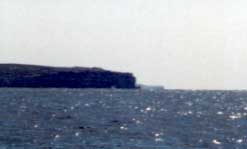 |  |
The north mark
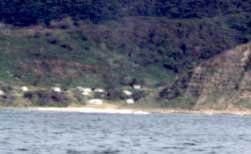
Line up point with hump at Cape Baily | The south-west mark
Line up the left of the top right house with
right of house closer to beach (note colour is now
green and the house above does not exist) |
The Undola is a bit more difficult to find than the Tuggerah as it is a much smaller and lower wreck. However, once you have the right marks, it is fairly easy to locate. Once you arrive at the GPS Mark (it will put you right over the wreck), line up the mound at Cape Baily off to the north with the pointy rock at the tip of Marley Point as per the diagram above. Run north on this (perhaps the point a bit to the right of the mound's apex). You should be over the wreck when the houses are as above. This should be right near the engine or boiler but could be in front of it.
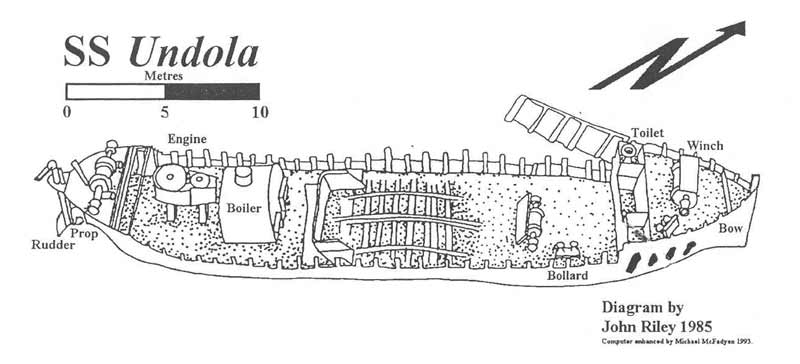 |
A diagram of the SS Undola by John Riley from 1985 that I enhanced and used in an article I wrote back in 1993
Today it is still much the same, except the middle section has collapsed out to the starboard
John Riley Memorial Collection, Heritage Branch, OEH |
Anchoring can also be a problem as there is sand in between the boiler and the bow of the wreck. There is not much metal here, or at least a lot of spots where the anchor can drag right across from one side to the other without hooking on. At times we have had three goes without hooking the wreck and we have had to go down as soon as we have dropped the anchor to hook it in.
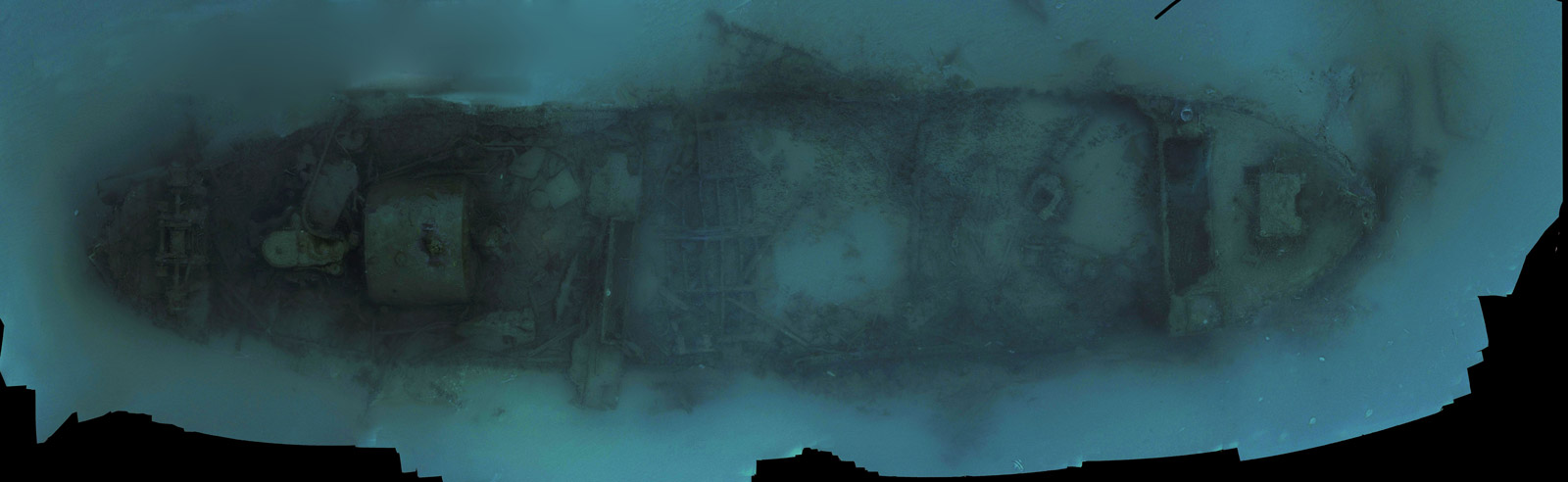 |
A moasic photograph of the wreck done by Scott Willan in 2014 shows the true scope of the wreck
Click to see larger version - provided by Scott Willan - NSW Wrecks Info Web Site |
Today, the Undola lies upright on the bottom (supporting my theory that it did not turn turtle), with its bow facing to the north-east. Assuming that your anchor is near the boiler, the following is a description of the wreck and a suggested route to examine all the wreck. As I have mentioned, the wreck is much smaller than the Tuggerah and you can easily swim right around the wreck in about 12 minutes or less.
To the south-west of the anchor you should see the boiler. It is not as big as the Tuggerah's two boilers and about the same size as the SS Annie M. Miller's boiler. The steam pipes are home to eels, congers and morays. Follow the boiler to the south-west on the southern side. The rear section of the ship is the most intact. See the photographs above that show this area taken as I ascend after a dive.
 |
The rear section of the Undola on a day of very good visibility
The boiler is on the right, the engine in the centre and the stern under the yellowtail and seapike |
Soon you will see the engine which is easily visible. The engine is a triple-expansion steam engine and it sits up high over the rest of the wreck. Under the engine area, a number of interesting things have been found. On one dive, my buddy found a fob watch and on another dive I found a human vertebrae. In August 2009 there was a bit of new damage to sections of the engine, probably from the big seas that hit Sydney over the previous month,
You can also see under the stern deck into what was probably a compartment of some sort. There is a large winch in this area (see the photograph). The rudder post stands high above the stern. The steering arm used to be hard to starboard and on it there was a ceramic frog, put there in the mid-1990s by a diver from Shiprock Dive Shop. This was totally overgrown and almost impossible to see. However, in about May 2011 the arm fell to the sand below.
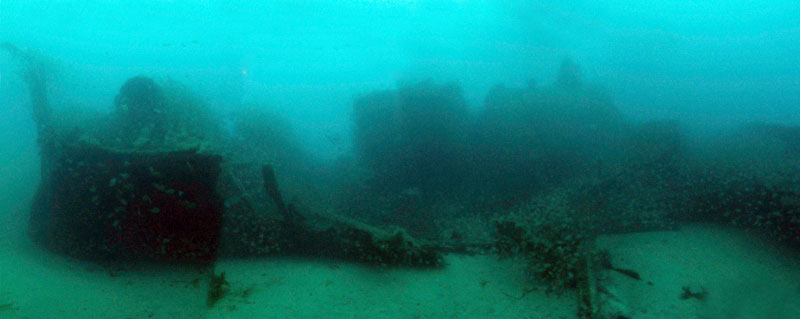 |
A panoramic photgraph of the rear section of the Undola
The rudder is on the left , the engine in the centre and the boiler on the right |
On the port side of the boiler a section of the hull fell inwards in late 1998 or early 1999. In 2003 a lot of sand was moved out from under the engine by storms. On the port side of the engine there is a 44 gallon (200 litre) drum that was obviously inside the engine room.
The area in front of the boiler is well broken up, with only beams, cross-members and some hull remaining. However, the bits are still very much in the shape of a vessel, the the sides of the hull mostly in place. There are some pieces sticking up from the sand. The hatches are also very obvious, they still remain, although much lower than where they originally were in relation to the engine/boiler.
 | 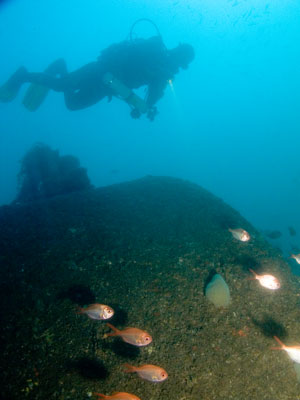 |
| Robby Mapstone and Andreas Thimm and the boiler | Robby Mapstone and the boiler |
 |  |
The stern of the Undola in 30 metre visibility
The rudder in the photo below is on the left and the winch in middle | The rudder post of the Undola - note the arm has now fallen to the sand |
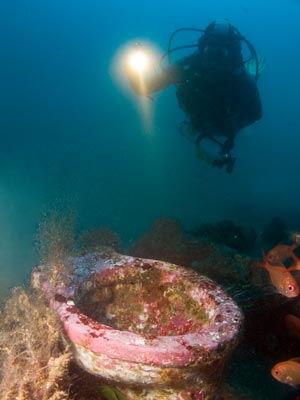
Towards the bow on the port side you will find the remains of the two most photographed features of the Undola. The first of these is the toilet which sits out in the open. You can still read the name of the manufacturer, "Shanks & Co. Ltd, Patentees, Victorian Pottery, Barrhead", on the inside of the bowl! Barrhead is in Scotland and Shanks and Co were one of the biggest makers of toilet in the world.
 | 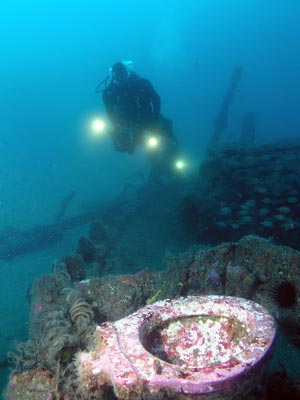 |
| The toilet of the Undola and behind the bow | Another shot of the toilet, this
time with Max Gleeson (two lights) and Peter Flockart |
However, from early 2002 to present there has been growth over the whole bowl as there are no as many divers visiting this wreck. For most of this period the name could not be read. As I could not scrape the growth off with my gloves I meant to take something down with me to clean it (I was not carrying a knife at this time). On a dive on 2 August 2009 I cleaned the area around the name (it had been cleaned a bit by someone else). Now I try to to clean the whole toilet whenever I visit (should I take a toilet brush?). In February 2016 and July 2018 I again cleaned the name and part of the toilet, but it really needs something better than my small dive knife.
The second feature are the remains of the fishing nets which were hooked onto the wreck and used to reach towards the surface, supported by numerous buoys. However, the major part of the nets are now gone (they disappeared in late 1994 or early 1995) and only bits remain lower on the wreck.
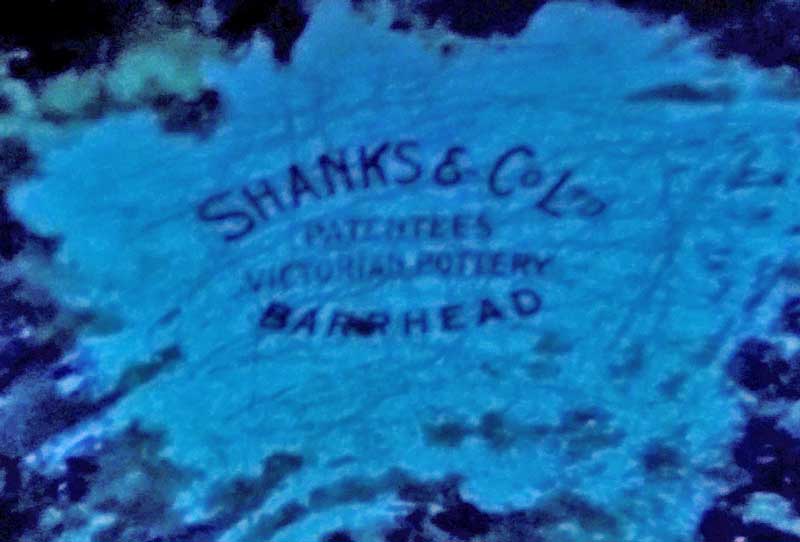 |
| A closeup of the name inside the toilet bowl |
After checking out the toilet, head along to the bow. The bow sits higher up than the middle section of the wreck. Again, like the stern you can look into it. On top is a large winch. Until about February 2016 the deck it sat on was roughly intact. The winch has now caused the deck under it to partially collapse, especially on the rear side. From here head back along the starboard side of the wreck. You will see similar things on this side to the port side. End your dive around the boiler area.
The diagram by John Riley is a fairly accurate representation of what the Undola looks like now. The only major changes are that there are some remains of fishing nets over the starboard side of the engine and some small sections of the starboard hull have collapsed outwards, sometimes pulling other parts with them. The small size of the wreck means that even on your first dive here you can get a brief overview of the whole wreck without going too far into decompression.
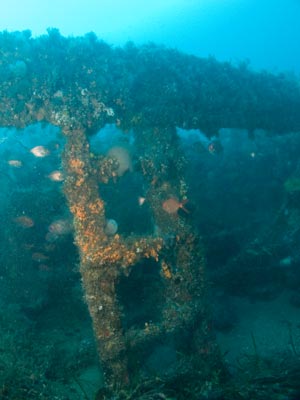 | 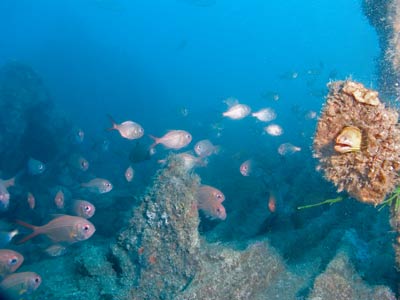 |
| The ladder into the second hold | A moray eel in a pipe in front of the boiler |
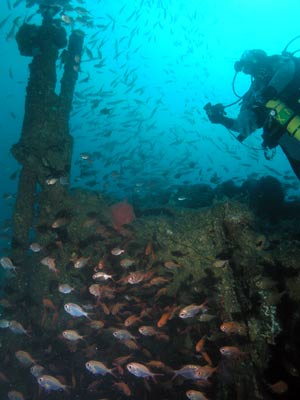 |  |
| Peter Flockart and the rudder post | Peter Flockart and the stern winch |
Like its more famous neighbour, the SS Tuggerah, the SS Undola is alive with fish. As well as the thousands of nannygais and bullseyes over the wreck, schools of yellowtail kingfish often visit and circle the wreck while huge old man snapper were present in 1996 in large numbers. You also get huge schools of seapike, yellowtail and silver sweep on the wreck. Sunfish and seals have been known to drop in on divers. The boiler tubes are home to conger and moray eels and the sand supports numbrays, sea pens and serpent eels.
The Undola sometimes has a current from the north so you will need to check after anchoring. However, many times I have dived here after abandoning attempts to dive the Tuggerah due to the extremely strong currents there, even though the Undola is further off the coast than the Tuggerah. On these occasions we have normally found no current at all although on 5 August 1998 after abandoning an attempt to dive the Tuggerah due to the current, we also had to abandon a dive here as well. The visibility is usually good and more recently I have averaged more than 20 metres.
On 21 June 1998 we had at least 35 metres and on 9 June 2004 about 20 metres. Do not be put off by dirty water on the way down, it can be quite clear at the bottom.
 |  |
| Yet one more shot with Robby Mapstone | The starboard anchor howser pipe at the bow |
This shipwreck is a deep dive and only for experienced deep divers. Unless you have experience in Sydney or further south of deep diving (over 40 metres), you should not do this dive without being under the supervision of a very experienced buddy. The only dive charter boat that visits this site is Abyss's Sea Dragon II (very rarely). Sorry, but this is the pathetic state of the Sydney dive business as no charter boat is operating full time out of Port Hacking (there were three at one time). The only way sure way you will be able to dive is with an individual or a private club.
This is a great dive, well worth the effort.
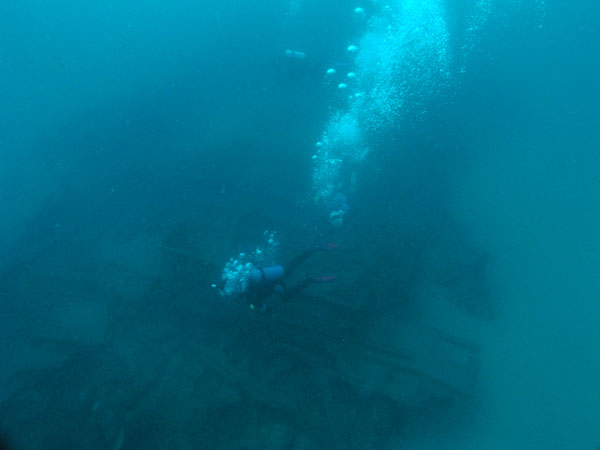 |
Sheila Baldock and Les Caterson hover over the middle
section of the Undola in very good visibility |
Click here for more photographs of the SS Undola.
Visibility Summary:
| Visibility | Dives |
| Excellent | 5 |
| Very Good | 12 |
| Good | 16 |
| Fair | 7 |
| Poor or Worse | 3 |
References:
SS Undola: A Collier in the Illawarra Trade by B. Rogers
Sydney Morning Herald 24, 25, 28 and 30 December 1918,
1 and 7 January 1919
Lloyds Register 1917-18
State Archives of NSW
Vanished Fleet of the Sydney Coastline by Max Gleeson
Argus - Thursday 30 August 1917
The Advertiser - Friday 14 January 1910, page 6
The Advertiser - Thursday 26 January 1910, page 6
The Advertiser - Thursday 19 October 1911, page 10
Argus - Wednesday 25, Friday 27, Saturday 28 December 1918
Email from Peter Goulden dated 20 September 2015
NOTE: And the thing in common with RMS Titanic? The bathroom fittings on the Titanic were also made by Shanks and Co of Barrhead, Scotland, the maker of the Undola's toilet!!. | 



 v6.00.307 © 2003-2005


