Michael McFadyen's Scuba Diving - Bare Island Right
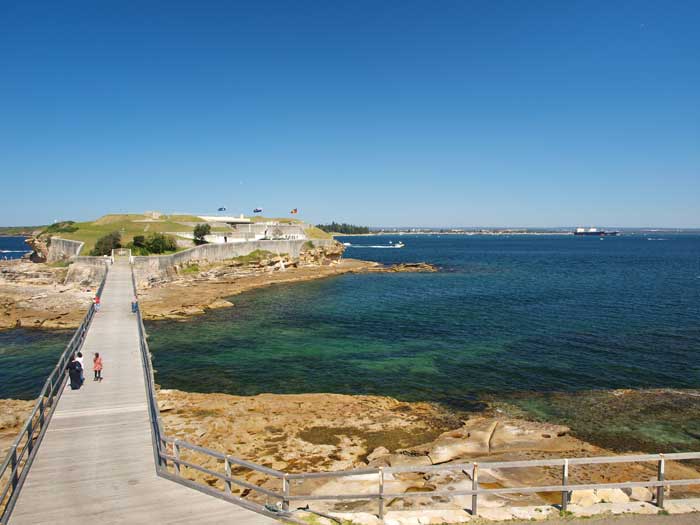 |
A photograph of Bare Island Right on a perfect day
The exit site is on the island just to the right of the bridge
Entry points are the same spot or just below the rocks jutting out to the right of the island |
NOTE: AS OF 1 SEPTEMBER 2026, ACCESS ACROSS THE BRIDGE IS NOT POSSIBLE DUE TO BRIDGE RECONSTRUCTION AND THIS SITE CAN ONLY BE DIVED FROM THE MAINLAND
In other articles on this web site, I have described dives at my favourite shore dive site, Bare Island and the location I have dived most (as of July 2006, more than 175 times). In this article I will describe another dive that you can do at Bare Island. Located 20 kilometres from the centre of Sydney, Bare Island is part of Botany Bay National Park. From the city, travel along Anzac Parade or Bunnerong Road to La Perouse.
Upon arriving at La Perouse, park on the edge of Anzac Parade above the island as close to the island's access road as you can. Walk to the edge of the headland overlooking the island to check the water conditions as well as the entry and exit points. This dive can be done in virtually all seas, even those from the southeast. I have dived here many times when surfers have been surfing off the eastern end of the bridge that joins the island to the mainland. It is only in the hugest of seas that you cannot dive this site. One thing that can affect the site is that after prolonged periods of very heavy rain, the visibility can be reduced to one or two metres.
 |  |
| A drone photograph of Bare Island from the north | A drone photo of Bare Island from the south |
If you asked me back in the mid-1990s I would have said that even at its best, the visibility only got to four or five metres. However, since about 1999, visibility here has improved dramatically. The visibility has averaged almost 10 metres on these dives. It is certainly much better than the previous 13 years. In May 2003 I dived here and had 15 metres and on 13 December 2003 at least 15 metres. Since then I have had a couple of 20 plus metre viz dives amd on 7 May 2006 it was about 30 metres above 14 metres. The tides do not really have much impact on a dive although sometimes an outgoing tide can cause a current in the deep section of the dive. Visibility is sometimes better on high tide but I have also had good visibility at low tide.
This dive begins on the island. Gear up and walk across the bridge and climb down the stairs it used to be a ladder and you had to climb over the railing!) and go under the bridge. Normally I enter the water out as far as is safe, but for first timers, the best place to start is near the small boat launch ramp (Boat Ramp) cut into the rock platform. If it is very calm, I walk right out to the westernmost point of the island and enter here. However, until you have a bit of experience of this dive, start at the boat ramp.
BASIC BARE ISLAND RIGHT DIVE
For your first dive at this site, you should follow the following directions. Once you have dived the site this way a few times, then try the other options. The reef is roughly located at GPS 33° 59' 30.066"S 151° 13' 46.294"E using WGS84 as a datum.
 |  |
| A satellite photograph of Bare Island showing the reef | A map of Bare Island (Right) I drew in the early 1990s
Click to enlarge |
This starts at the Boat Ramp mentioned above. Enter the water and drop to the bottom. It is about three metres deep. Head to the north-west and you will gradually get deeper. After 15 metres you will go over a small reef. Turn to your left and head south-west across the sandy bottom. After about five minutes you will reach the main reef which is the location of the Shark Fin and Outboard Motor (see description page - link at bottom - for photos and more details). As you go you may see things like large flathead, numbray, small rays and flounder. The depth will be about five to six metres on the sand.
 |  |
A new underwater map of Bare Island created by Marco Bordieri from www.viz.net.au.
For a much larger pdf version of this map, click here.
Used with permission of Marco Bordieri | Information about the map at left and below |
Where you meet the reef is the main section of the reef and you should follow the edge (on your left) as it goes first north-west and then west. Keep to the main flat reef and you will sort of swim through a gutter (large whitish rocks on left and a "wall" of kelp on right) with a flat rocky bottom. After about 25 metres you will cross over onto sand. The reef continues on your left and turns a little to the south-west. In March 2001 while diving in this area, I saw four huge flathead on the sand here. Three minutes from the Shark Fin and you will see the first Orange Sponge.
 |
A new underwater map of Bare Island created by Marco Bordieri from www.viz.net.au.
For a much larger pdf version of this map, click here.
Used with permission of Marco Bordieri |
Another 25 metres further on a sandy finger runs to the left into the reef (depth 8 metres). This finger goes off in a south-westerly direction while the main reef goes west. In poor visibility this can cause confusion and cause you to move away from the real edge of the reef up onto the top of the reef. Care needs to be taken as this leads to an area where you can get lost and not easily find your way back to the reef edge. If this occurs, head in a northerly direction until you regain the sand.
Just before here and a minute from the previous orange sponge, you should pass over another orange sponge. Turn a little to the right and continue on. You will pass over some very low rocks with kelp (the cover of sand on these rocks has varied a lot over the period 2020 to 2026). Then you will see the remains of a 44 gallon drum. Once again, the sand cover has changed a lot and since mid-2024 it is almost covered after a period of less sand.
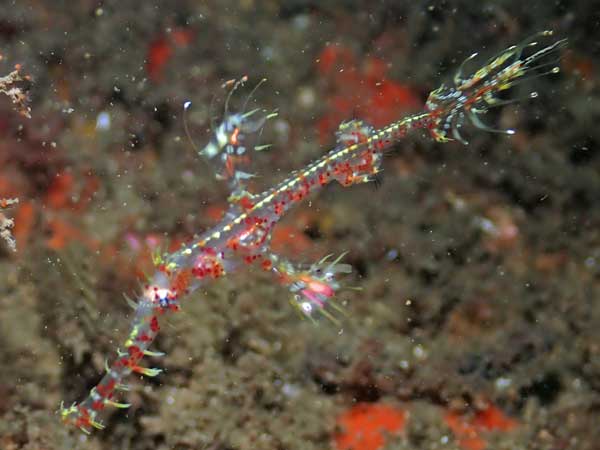 | 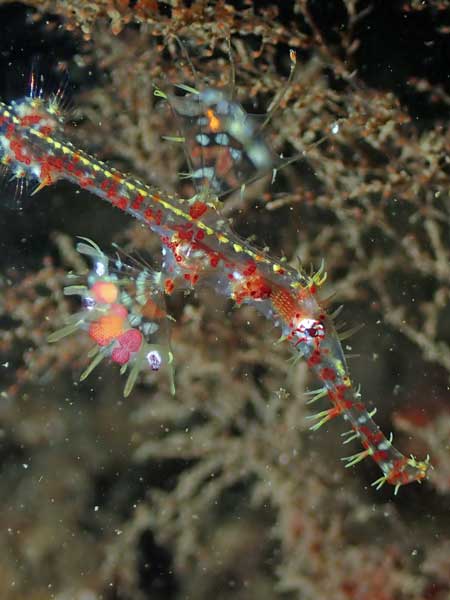 |
| An ornate ghost pipefish | Another photo of the same ornate ghost pipefish |
Near this location there are some large boulders out on the sand. There are about five large boulders and they are covered in sea tulips. We call this Sea Tulip Rocks. There are also two kelp covered rocks on the right which are home to sea horses a lot of the time. In this area the depth is about 8.5 to 9 metres. In this area there are often red Indianfish, we have been seeing them on this dive nearly every dive since about 2004 (except for 18 months from early 2022 after record rainfalls and from December 2024 till April 2026). See the photo towards the bottom of the page.
 |  |
| A red Indianfish shedding its skin on 11 July 2024 | The red Indianfish has shedded its skin more |
Past here there is a very prominent wall with more bits of reef or low isolated rocks located off the wall. There are also lots of old bits from the bridge (pylons and decking). Examine the rocks, the overhangs, the (normally dead bits of) kelp on the sand. You will find some amazing fish here. These are also home at times to red Indianfish. In July 2024 we saw one shedding its skin. See photos below.
We see pygmy pipe horses in this area as well, although you need to look very carefully to find them. They can be brown, bright red or even white. We have seen some with gold or silvery stomachs. There are also sometimes small painted anglerfish.
 |  |
| A wobbegong above the Main Cave 1 May 2026 | Spindle cowries are found above the Main Cave on fans |
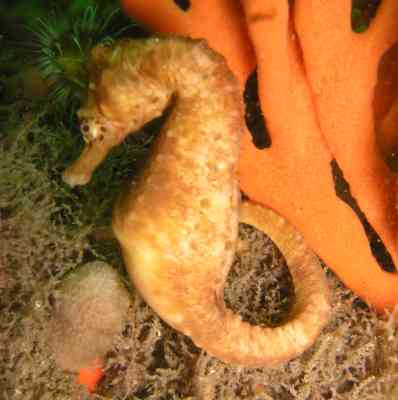
For a long time there used to be three big belly sea horses on the sponges on the isolated rocks at about 11 to 12 metres. We call this Sea Horse Rock. Look for a rock that has the top in about 12 metres at mid-tide. On the eastern side of this rock there is a long piece of pylon from the bridge (narrow diameter but long) lying across your route and another fatter (about 0.75 metre diameter and 1.5 metres long) piece that lies facing parallel to the wall.
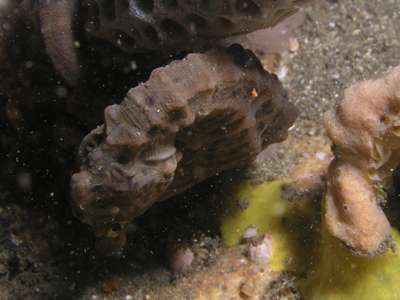
On the western side of this rock there were three sea horses. I first saw one of them in March 2003 and found the others soon after. The original sea horse appeared on 12 November 2003 to be "pregnant". The second sea horse was very pregnant on 26 December 2003. However, it was not pregnant as of 4 January 2004. There was another sea horse here as well. All these sea horses were fairly easy to distinguish, as they have some quite unique markings. See the table below for details of sightings as well as some photographs. There were there for about three years till early 2006.
Sea horses seen right side of Bare Island - On Sea Horse Rock at 12 metres
Blank indicates not seen
| Date | Sea horse A - Male | Sea horse B | Sea horse C | Comments |
|  |  |  | |
| Normally under grey sponge on
south but since 18/3/04 on B's sponge as in above photo
Click above photo to enlarge | Normally near orange sponge at north but early 2004 on sand to south between rocks and May 2004 E of sponge | Normally on side of rock SW corner | |
| 29 Mar 2003 | | Seen | | |
| 28 Apr 2003 | | Seen | | |
| 31 Aug 2003 | Yellow
See photo | Seen | | |
| 24 Sep 2003 | Yellow | Yellow
See photo | | |
| 8 Oct 2003 | Pale yellow | Very bright yellow
See photo | | |
| 10 Oct 2003 | Not seen | Very bright yellow and appears pregnant | | |
| 12 Nov 2003 | Pale yellow but pregnant | Not seen | | |
| 13 Dec 2003 | Pale brown | Yellow with red tinge | | |
| 26 Dec 2003 | Pale brown | Not seen | Pale grey and pregnant
See photo | |
| 2 Jan 2004 | Pale brown | Pale yellow with red tinge | Pale grey and not pregnant | |
| 4 Jan 2004 | Pale brown | Pale yellow with red tinge | Pale grey | |
| 15 Feb 2004 | Pale brown and skinny | Pale yellow with red tinge and very skinny | Pale grey and a bit gaunt | |
| 28 Feb 2004 | Pale yellow, skinny more prominent spots | Not seen | Pale grey and a bit gaunt | |
| 6 Mar 2004 | Pale yellow, skinny more prominent spots | Pale yellow and very skinny | Pale grey and a bit gaunt | |
| 18 Mar 2004 | Pale yellow, skinny more prominent spots | Pale yellow and very skinny | Pale grey and a bit gaunt | |
| 6 Apr 2004 | Pale brown, skinny more prominent spots | Pale yellow and very skinny | Pinky colour and very thin | |
| 18 Apr 2004 | Pale yellow, skinny more prominent spots | Not seen | Very red colour and very thin | |
| 16 May 2004 | Pale brown, skinny more prominent spots | Yellow with pink tinge and less skinny | Very red colour and a bit gaunt | |
| 27 June 2004 | Pale brown, skinny more prominent spots | Yellow with pink tinge and skinny | Dark brown and quite skinny | |
| 2 July 2004 | Pale brown, skinny more prominent spots | Yellow with pink tinge and skinny | Dark brown but more prominent belly | |
| 11 July 2004 | Pale brown, skinny more prominent spots | Yellow with pink tinge and very skinny | Brown/red and very prominent spots | |
| 12 Aug 2004 | Pale brown, skinny more prominent spots | Yellow and very skinny | Brown/red and very prominent spots | |
| 26 Aug 2004 | Pale brown, very skinny and more prominent spots | Yellow and very skinny | Brown/red, skinny and very prominent spots | |
| 17 Oct 2004 | Pale brown and not as skinny | Yellow with pink tinge | Brown/red and not as skinny | |
| 18 Nov 2004 | Pale brown and not as skinny | Yellow with pink tinge, thicker | Brown/red and not as skinny | |
| 23 Dec 2004 | Pale brown and skinny | Yellow with pink tinge, thinner | Brown/red and skinny | |
| 3 Feb 2005 | Skinny | Yellow with purple edge, big belly | Bown/red sand skinny | |
| 20 Feb 2005 | Pale brown, skinny but very prominent belly | Yellow with a bit of purple, skinny | Brown/red and skinny | |
| 20 Feb 2005 | 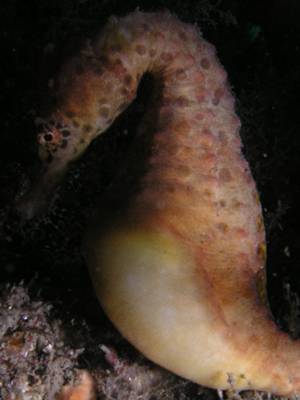 |  |  | |
| 27 Feb 2005 | Pale brown, skinny but very prominent belly | Yellow with a bit of purple, skinny | Brown/red and skinny | |
| 5 Mar 2005 | Pale brown, skinny and belly gone | As above - was on sand to SW of rock | Brown/red and bigger belly | |
| 24 Apr 2005 | Pale brown, skinny and belly white | Yellow | Brown/red and bigger belly | |
| 2 Jun 2005 | Pale brown, skinny and belly white | Yellow but not on normal rock - 5 m to west | Very red | |
| 9 Jul 2005 | Pale brown and skinny | Dirty yellow | Very red and dirty looking | |
| 28 Aug 2005 | Not seen | Bright yellow and large belly | Not seen | |
| 6 Oct 2005 | Not seen | Yellow and skinny and mauve on tail | Skinny and very pink | |
| 8 Oct 2005 | Not seen - May be dead? | Yellow and skinny and mauve on tail | Skinny and very pink | |
| 3 Nov 2005 | Assumed dead | 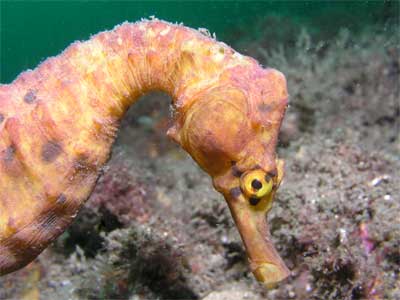 | Skinny and very dark mauve | |
| 4 Nov 2005 | Assumed dead | Yellow with pink tinge | Skinny and very dark mauve | |
| 8 Dec 2005 | Assumed dead | Yellow with pink tinge | Skinny and very dark mauve | |
| 23, 25 and 26 Dec 2005 | Assumed dead | Yellow with pink tinge | Skinny and very dark mauve | |
| 2 Jan 2006 | Assumed dead | Yellow with pink tinge | Very dark mauve | |
| 11 Jan 2006 | Assumed dead | Not seen | Not seen | |
| 22 Jan 2006 | Assumed dead | Not seen | Skinny and very dark mauve | |
| 27 Jan 2006 | Assumed dead | Assumed dead | Skinny and very dark mauve | |
| 28 Jan 2006 | Assumed dead | Assumed dead | not seen | |
| 29 Jan 2006 | Assumed dead | Assumed dead | Skinny and very dark mauve | |
2 and 23 Feb 2006
5 Mar 2006 | Assumed dead | Assumed dead | Assumed dead | |
However, in January 2006 the last of the sea horses was seen. They are now all assumed to be dead.
In January 2007 on a night dive I found a pygmy pipehorse living on Sea Horse Rock. It was tiny, only 10 mm long. I successfully refound it on a day dive three days later. It was much harder to see on this dive, even in some of my photos I cannot see it! It was here many times in January 2007 but on 7 February 2007 I could not find it. It was located just behind the yellow sponge next to the orange finger sponge on the north-western corner. Under Sea Horse Rock you will very often (90% I reckon) find upsidedown pipefish and sometimes other pipefish. There was even a tiny pineapplefish under the western side for months in late 2020 and early 2021.
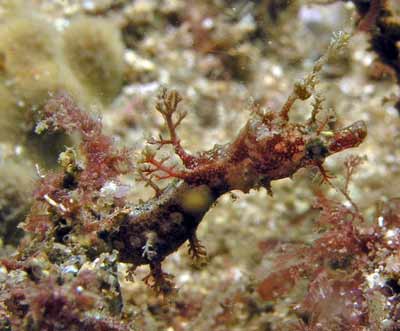 | 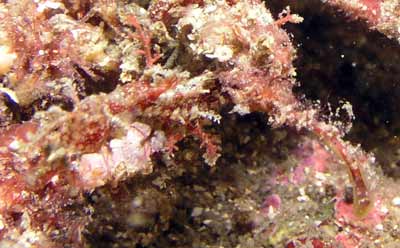 |
| A pygmy pipehorse on Sea Horse Rock | Can you see the same pygmy pipehorse?
Click on photo to see it |
Past here the wall turns a bit more to the north-north-west and drops a little to 13 metres. There are lots of large and small boulders off the wall. Some of them have small overhangs and many times I see upsidedown pipefish in them.
All along this section there used to be sea dragons. These used to be found on the sand interspersed with the kelp. Look around the rocks and in and under the kelp that sometimes accumulates here. However, since 2009 we have hardly seen any.
As well, there are often huge flathead to be found. These can be as long as your arm and even if you do not seen one, you may see the indentation in the sand where one has been lying. There are also many large octopus to be found under the boulders. In summer you will often find firefish in this area, I have seen five on one dive. We nearly always see red Indianfish in the dead kelp at about 14 metres. The depth keeps increasing till you get to 14 metres or so.
 | 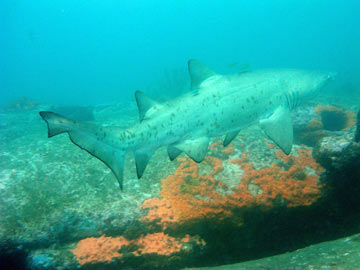 |
| A Grey nurse shark that I saw in the 13 metre area of Bare Island Right on 18 April 2007 |
Just past Sea Horse Rock I found a grey nurse shark on a dive on 18 April 2007. The shark was a small female, a bit over 1.5 metres long. She came in while I was taking photos of a small sea dragon and swam over to the wall, went up the top and to the west. She then came back to the bottom and went back east and then up over the reef top and disappeared to the south. This was the first grey nurse shark I have seen at Bare Island but I have seen them on the southern side of Botany Bay at Inscription Point and nearby.
We see pygmy pipehorses (they look like tiny sea horses) hidden in the red weed in this area for many years. Look for weed that moves out of sync with the current. Another way to find is to move your hand a few millimetres above the weed and watch for anything that moves trying to avoid your hand.
 |  |
The tiny yellow/orange painted anglerfish
Note very poor photo - slightly blurry | Another painted anglerfish, this one was 3 mm long - 1 May 2026 |
About 20 minutes of exploration from the start along the main sand edge (basically travelling due west) will bring you to a location where the rocks off the wall have been left behind. On a small rock just off the main wall in August 2006 a friend found a tiny, 15 mm long, orange anglerfish. See the photograph above.
On 1 May 2026 I found another one, this was tiny, only 3 mm long at the most (see photo above right). This is the cutest fish I have ever seen, ever nicer than a pygmy pipehorse. In the second quarter of 2016 we saw as many as three tiny anglerfish here, two orange ones (10 and 15 mm when we first saw them) and a black one.
Just past here I found a sea horse on 26 January 2008. This was on one of the rocks about 10 metres off the wall.
 | 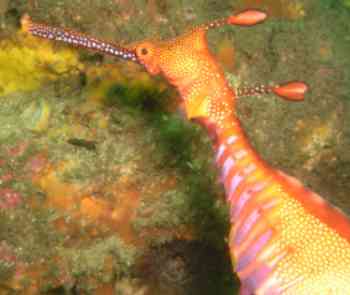 |
| A Whites sea horse I saw on 26 January 2008 | A close up of a common sea dragon |
Continue west and stick to the main wall rather than the rocks when the lower part of the reef heads off in a north-west direction. When the lower part runs off there are a few small boulders on the sand away from the main reef. There used to be more but they have been covered in sand for a couple of years. You should visit the rocks on your return trip. On the main reef in April 2025 there were two ornate ghost pipefish and two robust ghost pipefish. These were seen separately over two consecutive days. Amazing!
 |
A panoramic photo of the cave area on the right side of Bare Island
Taken 7 May 2006 with 30 metre visibility |
About 20 metres on there is a low but deep overhang. This is home to lots of fishlife, and in August is normally full of Port Jackson sharks. A bit further along and deeper there is another larger and deeper overhang (The Cave). The depth is about 14 to 15 metres. Inside you will find heaps of colourful marine growths including gorgonias.
A resident blue groper can often be found in the cave as well as the usual cave dwellers like estuary catfish, Sydney cardinalfish, yellow banded sea perch, eastern blue devilfish and half-banded sea perch. Outside the cave on the rocks there are sponges of all colours as well as giant ascidians, lace coral and Bairds solitary coral. You will have noticed these for the past 50 metres or so. I have seen Bare Island anglerfish outside the cave.
Go a bit further along and you will see a crack with some sea tulips above. These used to have some fantastic things living on them. What were they? More big belly sea horses. Way back I was told that there were three but on 11 July 2004 when I first found these sea horses, we found four. There were at least six separate sea horses living here in 2004 to 2005 but by late 2005 I could only regularly find two. Sometimes they could be about five metres further on under a low overhang or less often on the top of the overhang. We call this Sea Horse Corner. However, since about 2010 we have seen very few.
 |  |
This is the yellow Whites sea horse
seen from 26 January till 3 July 2011 | A couple of made-up phyllodesmium nudibranchs
aka opera house nudis |
Note that if you go to the right (west) from the corner, there are sometimes sea horses on the orange sponges about 10 metres along. From 26 January 2011 till at least 3 July 2011 there was a bright yellow Whites sea horse and a pale yellow Whites sea horse in this area.
This is about as far as you will get, especially if you are less experienced and not good on your air (you may not have even got this far). Before heading back, check out the boulders and reef in front of the Sea Horse Corner. At night or in very poor visibility, do not stray too far as you will end up running into the start of Isolated Reefs and can easily get lost.
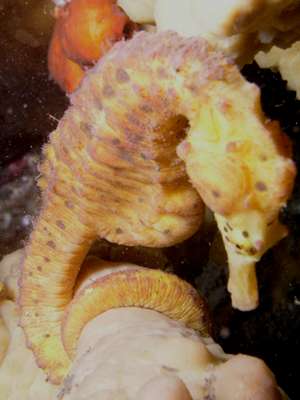
This table shows a record of some more sea horses seen at Bare island.
Sea horses seen right side of Bare Island - On sea tulips at 12 metres
Blank indicates not seen
| Date | Sea horse D | Sea horse E | Sea horse F | Sea horse G | Big Belly H | Big Belly I |
|  |
 |
 |
 |
| |
| Found at base of yellow sea squirt | Found on purple sea squirt base | Base of white sponge | Light pink sea tulip | | |
| 11 Jul 2004 | Pale yellow, skinny and lots of spots | Bright yellow, skinny but prominent belly | Dark grey and many spots | Yellow with purple tinge and pale spots | | |
| 12 Aug 2004 | Pale yellow, skinny and lots of spots | Bright yellow, skinny but prominent belly | Not seen | Not seen | | |
| 17 Oct 2004 | Not seen | Not seen | Not seen | Not seen | | |
| 18 Nov 2004 | Brighter yellow | Brighter yellow | | Brighter yellow | | |
| 6 Feb 2005 | | Yellow prominent spots | | Yellow prominent spots | | |
| 20 Feb 2005 | Pale yellow with big belly | | | Dirty Yellow and skinny | Bright yellow and skinny | |
| 20 Feb 2005 |  | | | 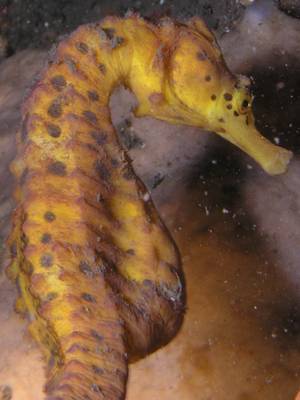 | 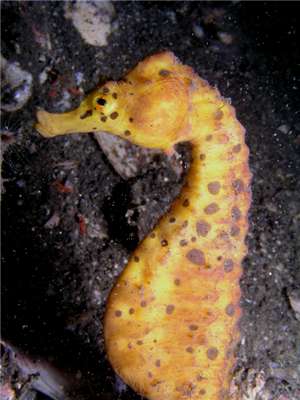 |  |
| 27 Feb 2005 | Pale yellow with big belly | Seen | Seen | Dirty Yellow and skinny | Bright yellow and skinny | Pale yellow and skinny |
| 5 Mar 2005 | Pale yellow with big belly | | | | | Pale yellow and skinny |
| 9 Jul 2005 | White with medium belly | | | | | |
| 28 Aug 2005 | None seen at all | | | | | |
| 8 Oct 2005 | None seen at all | | | | | |
| 3 Nov 2005 | | | | Bright yellow | | Pale with big belly |
| 4 Nov 2005 | | | | Bright yellow | | Pale with big belly |
| 8 Dec 2005 | | | | Bright yellow | | Pale with big belly |
| 23, 25 and 26 Dec 2005 | Pale yellow with big belly | | | Bright yellow | | |
| 20 Apr 2006 | Not seen | | | Not seen | | |
| 22 Apr 2006 | Not seen | | | Bright yellow | | |
23 Feb 2006
5 Mar 2006 | As above | | | Bright yellow | | Not seen |
| 20 Apr 2006 | Not seen | | | Not seen | | Not seen |
| 22Apr 2006 | Not seen | | | Bright yellow | | Not seen |
| 30 Apr 2006 | Not seen | | | Not seen | | Not seen |
| 23, 25 and 26 Dec 2005 | | | | 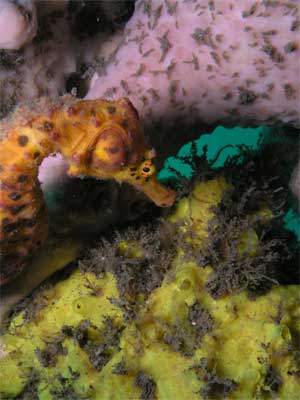 | | Pale with big belly |
| 2 Jan 2006 |  | | | Bright yellow |  | Not seen |
| 11 Jan 2006 | As above | | | As above | | Not seen |
| 22 Jan 2006 | As above | | | As above | | Not seen |
| 29 Jan 2006 | As above | | | Not seen | | Not seen |
23 Feb 2006
5 Mar 2006 | As above | | | Bright yellow | | Not seen |
| 22 Apr 2006 | | | | |  | |
| 4 & 7 May 2006 | Not seen | | | Not seen | | Not seen |
| 6 Aug 2006 | Not seen | | | Not seen | | Not seen |
| 21 Jan 2007 | Not seen | | | Not seen | 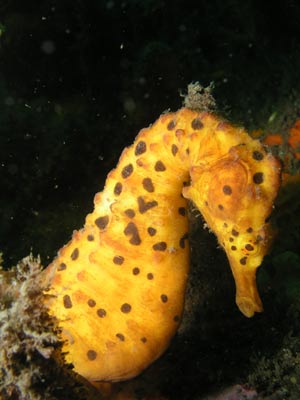 | Not seen |
If you follow the reef edge past the cave, the main part of the reef turns a bit to the south-west until it becomes less distinct. See later for a description of turning continuing west. On an outgoing tide you may feel current taking you to your left (south-east). It should not get too strong. It should have taken you anywhere from 15 minutes (if you did not stop) or 30 minutes if you went slow to get to here.
SEA DRAGON SIGHTINGS
The following is a table showing my sightings of sea dragons on the right side of Bare Island. This includes Bare Island Deep Wall and Bare Island Isolated Reefs. Numbers seem to peak in Winter and are at their lowest in Summer. This is a first, showing that sea dragons may move long distances. For more information about sea dragons, see my Sea Dragon Page.
Sea dragons at Bare Island Right
| DATE | NUMBER | COMMENTS |
| 11-Aug-1996 | 6 | |
| 19-Sep-1996 | 3 | |
| 15-May-1997 | 2 | |
| 2-Sep-1997 | 9 | |
| 14-Sep-1997 | 1 | male with eggs |
| 10-Jan-1999 | 2 | |
| 19-Dec-1999 | 1 | |
| 27-Dec-2001 | 4 | 2 males with eggs |
| 20-Feb-2002 | 0 | |
| 9-Mar-2002 | 5 | |
| 17-Mar-2002 | 3 | |
| 5-Apr-2002 | 2 | |
| 7-Apr-2002 | 1 | |
| 7-Apr-2002 | 2 | second dive |
| 26-May-2002 | 8 | |
| 9-Jun-2002 | 6 | |
| 21-Aug-2002 | 0 | |
| 11-Oct-2002 | 3 | |
| 29-Mar-2003 | 0 | |
| 28-Apr-2003 | 1 | |
| 31-Aug-2003 | 3 | 1 male with eggs |
| 24-Sep-2003 | 1 | different male with eggs to above |
| 8-Oct-2003 | 0 | very poor viz so hard to see |
| 10-Oct-2003 | 0 | passed by on way from back |
| 13-Dec-2003 | 1 | Same one as 24 Sept, still with eggs |
| 26-Dec-2003 | 3 | All on deeper reef |
| 2-Jan-2004 | 5 | All on deeper wall |
| 27-Jun-2004 | 1 | Not really looking for them |
| 11-Dec-2004 | 1 | One with eggs |
| 12-Dec-2004 | 10 | Three with eggs |
| 5-Feb-2005 | 3 | |
| 20-Feb-2005 | 0 | |
| 27-Feb-2005 | 1 | |
| 5-Mar-2005 | 0 | |
| 24-Apr-2005 | 0 | |
| 2-Jun-2005 | 2 | |
| 9-Jul-2005 | 0 | |
| 28-Aug-2005 | 3 | One with eggs |
| 6-Oct-2005 | 1 | Missing end of tail |
| 8-Oct-2005 | 2 | |
| 3-Nov-2005 | 3 | Two with eggs |
| 8-Dec-2005 | 2 | Very poor visibility |
| 23 and 25 Dec-2005 | 2 | Each dive |
| 2-Jan-2006 | 0 | Poor visibility |
| 11-Jan-2006 | 1 | Remains of eggs on tail |
| 22-Jan-2006 | 2 | |
| 27-Jan-2006 | 0 | |
| 28-Jan-2006 | 2 | |
| 29-Jan-2006 | 1 | |
| 30-Apr-2006 | 0 | |
| 4-May-2006 | 2 | |
| 7-May-2006 | 0 | |
| 6-Aug-2006 | 3 | |
| 29-Aug-2006 | 3 | Two pregnant males |
| 14-Jan-2007 | 3 | One tiny one about 100 mm long |
| 26-Aug-2007 | 1 | Note first dive here since Jan as bridge closed for repairs |
| 4-Oct-2007 | 0 | |
| 7-Oct-2007 | 2 | One pregnant |
| 28-Oct-2007 | 1 | |
| 6-Dec-2007 | 2 | |
| 8-Dec-2007 | 2 | |
| 22-Dec-2007 | 2 | |
| 5-Jan-2008 | 0 | |
| 6-Jan-2008 | 0 | |
| 10-Jan-2008 | 3 | |
| 20-Jan-2008 | 0 | |
| 26-Jan-2008 | 2 | |
| 24-Apr-2008 | 4 | |
| 29-May-2008 | 2 | |
| 6-Jul-2008 | 1 | |
| 19-Nov-2008 | 1 | |
| 20-Nov-2008 | 2 | |
| 27-Nov-2008 | 0 | |
| 18-Dec-2008 | 2 | |
| 30-Dec-2008 | 0 | Did two dives |
| 4-Jan-2009 | 0 | |
| 5-Feb-2009 | 0 | |
| 22-Mar-2009 | 2 | |
| 29-Nov-2009 | 3 | |
| 3-Dec-2009 | 3 | |
| 11-Jan-2010 | 2 | |
| 24-Jan-2010 | 1 | |
| 18-Mar-2010 | 0 | |
| 15-Apr-2010 | 4 | |
29-Apr-2010 to
12-Oct-2023 | 0 | Despite more than 200 dives here, no sea dragons seen at all |
| 12-Oct-2023 | 1 | Juvenile |
| 21-Oct-2023 | 0 | |
| 24-Oct-2023 | 1 | Same Juvenile |
| 31-Oct-2023 | 0 | |
| 8-Nov-2023 | 0 | |
| 22-Nov-2023 | 0 | |
| 7-Dec-2023 | 1 | Juvenile |
| 12-Dec-2023 | 0 | |
Return back by following the sand edge and the outer rocks.
Once you reach the spot where you met the first reef (Shark Fin), turn right and follow the kelp edge and follow it for about five minutes. Make sure you are gradually getting shallower. On the sand you can often see flathead, stingarees and numbfish in this area.
Eventually the water depth comes up to three to four metres and you should have crossed a bit of kelp and weed into a sand channel. Follow this to the north-east and when you see a pile of small rocks lying on the sand (I put larger ones there in about 2010 but dive shops moved them so about 2022 I started putting smaller ones there to indicate the exit spot). Turn right and go up over the kelp covered rocks. This will take you to the exit at the Boat Ramp, but if you run short on air, you can exit anywhere along the reef after you have passed the point mentioned in the paragraph.
 |  |
| One of five sawtooth pipefish seen 1 May 2026 | A red Indianfish at Bare Island |
Once you are more experienced, try out the deeper dives on the right side of Bare Island. There are a few including the Isolated Reefs, 15 Metre Reef and the Deep Wall. A list of commonly seen (and rarer) fish, sea dragon sightings and warnings are on the Bare Island Right page.
ALTERNATE ENTRY POINTS FOR BASIC BARE ISLAND RIGHT DIVE
You can also enter further along the rock platform up to the Pool saving you some swimming time. You can also enter via the Pool. For the first ones, just swim out 10 metres or so and then following the above directions. For the Pool, once you swim out, head north and you will come out on the sand near the Orange Sponge/s.
MORE COMPLEX BARE ISLAND RIGHT DIVE
Enter off the Western Point. Once you swim out about 15 metres, head west-north-west for about four minutes. You will come to a depth of about 14 metres and sand. Turn right and follow the wall. You will come to Sea Horse Corner after another five minutes or so. Return back as per the dive above. Note I now call this dive the Not So Deep Wall.
NOTE:
All Italic names are described in detail (with photos) on the Bare Island - Geographical Definitions.
WHAT TO DO IF YOU GET LOST
First, do not ascend under any circumstances. Same goes if you lose your buddy. If you get lost or lose you r buddy, head north-east and you can never end up totally lost. You will either end up next to the island or on the mainland. Only surface once you are in very shallow water, that is, less than three metres.
| 



 v6.00.307 © 2003-2005