|
Michael McFadyen's Scuba Diving - Henry Leith
The town of Madang is often called the "prettiest town" in the whole Pacific. I must say that I agree with this description as it is very beautiful and ideally located on the shores of Madang Harbour, a harbour that comes close to Sydney Harbour in terms of size, protection and beauty. Numerous parks, lagoons and creeks are found in and around the town and there are plenty of trees that add to its appeal. To the north there are three other harbours, Nagada, Mililat and Sek Harbours. In reality, these are really just parts of the one, huge harbour protected from the open ocean (not that there is any real big seas) by a barrier reef and a number of small islands. The vast majority of the diving here is carried out in and around these harbours.
On my 1996 dive trip to Madang in Papua New Guinea, I was able to dive four wrecks, ranging from recently scuttled vessels to one over 50 years old.
At the northern end of Nagada Harbour there are a couple of islands, the smallest of which is Wangat (or Wangad or Wonad) Island. This is located only metres inside the barrier reef. The island is very small, it only takes a few minutes to walk across it. Located off this island are a couple of very interesting wrecks. One is the wreck of a North American B-25D Mitchell light bomber which is off the southern end of the island.
Off the south-western corner of the island is the wreck of the Henry Leith. This ship was built in Scotland and launched on 25 August 1887 as the Wybia from the Dumbarton shipyard of Scott and Sons Company. It was a steam powered tug boat, 106 feet long and 20.1 feet wide. It displaced 129 tons. The engine was a twin cylinder steam engine producing 66 nhp built by Ross and Duncan from Glasgow.
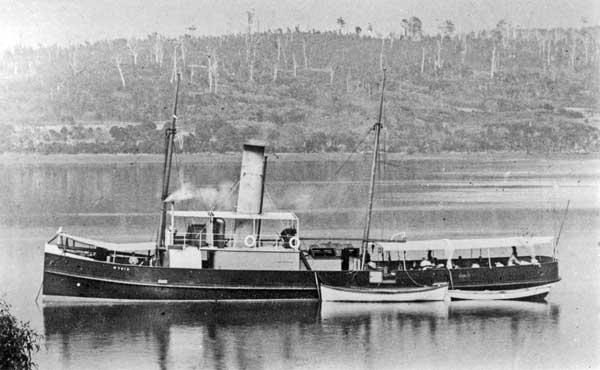 | 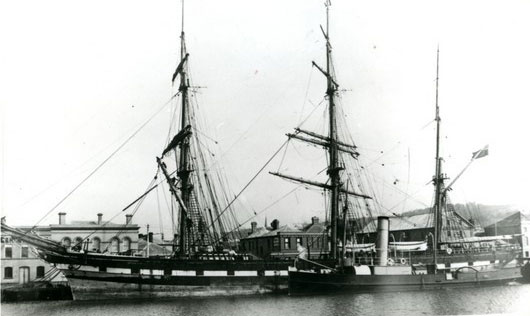 |
| The Wybia, probably on the Tamar River | The Wybia alongside the barque Castle Holme in Launceston |
The tug sailed for Australia and after a six month voyage, she arrived in Launceston, Tasmania. The Wybia was owned by the Launceston Marine Board and used as a tug for ships entering the Tamar River at Tamar Heads. In the next 23 years, she not only brought sailing ships in and out of the river, she was used for other important work. This including accompanying the damaged steamer Papanui from Tamar Heads to Port Phillip Heads in Victoria.
She was also used to search for survivors from a ship called Loch Finlas (she found some) and another shipwreck called SS Orion.
On 3 March 1911 The Wybia was in the Board's drydock for her annual overhaul. It was reported that she was in very good condition, including the bottom plates, boiler and engine. At the same time, rolling chocks feet long by 10 inches wide were installed to stop her propensity to roll when at sea.
In 1930 the Wybia was sold to the Geelong Harbour Trust and she moved across Bass Strait to Victoria. In 1933 she appears to have again changed ownership, this time to James Wallace Limited of Sydney, New South Wales. At some time she may have also changed name to McGregor or similar, but I am not sure if this is actually correct.
From 1944 to 1946 she was owned by the Australian Government and used for the Royal Australia Navy as AT382. It appears she was used in Sydney and Brisbane. In 1946 ownership changed back again to the Geelong Harbour Trust and on the Monday 8 April 1946 she arrived back in Melbourne after a hair-raising trip from Sydney during which she had a lot of water enter the ship. She was being returned to the Trust after being used in World War II.
In 1953 she was re-engined with twin six cylinder GM Detroit diesel engines which were placed in tandem driving the original single prop. She may have also become a fishing vessel. In 1965 she was re-engined again, this time with a single eight cylinder Gardner diesel of 250 bhp. She also was renamed as Henry Leith. I think she was sold again as well, but I cannot confirm this for a fact. I think she also returned being a tug.
In 1968 or 1969, the boat was again sold. It seems that the new owners were 21 year old Bernie Grant and a partner. They were based in Lae, Papua New Guinea. They had a small trucking company taking freight up to Mount Hagen and had decided to branch out into the small boat business. They intended to ship goods to islands and then bring back copra.
Bernie came down to Sydney searching for a suitable vessel. He found the Henry Leith anchored near Rose Bay. Warwick Earl (more about him later) thinks that she was then owned by a doctor who he thought had bought her for salvage work but had lost interest. She was rigged with reasonable winching gear and what Bernie liked about her was that she had a large hold for the copra. The hold had originally been a coal bunker as you will recall from above, when she was built in 1887 she was a steam tug.
Anyway, in 1968 a 17 year old Warwick Earl had been in a pub in Sydney when he met 21 year old Bernie Grant. Learning that Warwick had done a bit of sailing, Bernie offered him a job taking the Henry Leith from Sydney to Lae. Being unemployed at the time, Warwick quickly grabbed the chance of an adventurous journey to an exotic sounding place.
The Henry Leith was tied up to Mortlake Dock on the Parramatta River. Bernie and Warwick lived on board while extensive work was carried out trying to make her sea worthy. This included a lot of chipping and painting of the hull. Once Warwick chipped a hole right through the hull, a small hole but still an indication of the state she was in. When he told Bernie about it, he said “no worries I've got some epoxy filler, that will do the job�.
Another time Warwick had to crawl into the fuel tanks that had to be flushed out, so he was scrubbing them out with some chemical Bernie had given him. It was very cramped and dark and the fumes overwhelming. Warwick woke up on the deck coughing and spluttering. Bernie hired an oxygen mask and gear for him and he went back in.
Warwick was not being paid. The deal was an adventure, a possible job in Lae or a return flight to Australia. They worked on her continuously for a couple of months, living pretty rough. Most of the gear on board was either in great need of repair or just rubbish (eg lifejackets). These were the old kapok ones that went over your head with two straps either side, a problem, all were completely rotten, so if you gave them a hard pull, they just fell apart. Bernie said he was on a tight budget and it was a short trip and they would not need lifejackets.
Part of the preparation of getting the boat seaworthy was to have the compass swung by a professional surveyor or equivalent. One day a bloke arrived and they headed out into the Parramatta River where they did a number of maneuvers which corrected deviations in their very old compass in the wheelhouse. As the bloke left, Bernie muttered “highway robbery, tight budget�.
One morning a bloke turned up to the boat. His name was Simon. He was originally from Thursday Island and he was a real seaman. He had been sailing the world as a registered, union member sailor since he was 20. Bernie was well aware that just two people were incapable of taking the ship to sea on their own, even three was a joke as it turned out. But he had met Simon, again in a pub. Simon was down on his luck and when Bernie offered him a chance to sail north towards Thursday Island for free, he signed up.
So now there was a crew of three. They had been stocking up on supplies, very meager, and fuel. Then one morning, Bernie announced, "We're off tonight". The beginning of the end!
As Warwick found out later, they had no clearance from the Sydney Harbour Master, to leave the harbour without following certain protocols. That is why Bernie chose to leave at night. They sailed away under the Sydney Harbour Bridge, yelling and cheering themselves (with the help of a slab of VB), Warwick recalls that it was in early July as it was very cold.
During first night and morning (a foreboding of things to come?), Warwick was seasick but followed his father's advice to eat Sao biscuits which seemed to help. Then I fell asleep. Bernie was on watch that night.
The engine room became very familiar to Warwick as he, somehow, knowing bugger all about engines, became the ad hoc engineer! Warwick advised me that there were three marine Gardner engines but the records I have found only mention one. Perhaps more were added later? He said that they were all a bit iffy, as they were to learn later. Warwick's job was to check temperatures, oil pressures and top up frequently with oil. Also, check the shaft as required and check for leaks at the seal.
Warwick advised me that apart from the first night, he never got seasick even though he had good reason to be seasick with the fumes and rolling of the boat later in quite big seas.
On the trip north Warwick turned 18 years old.
They reached Gladstone in Queensland but were experiencing engine issues, so Bernie decidedthey had to go into port for repairs, despite the fact that they may be on harbour master's lookout for leaving Sydney in the manner they had. As it turned out, the Gladstone Harbour Master had heard of them. However, he and Bernie really hit it off, both liked a drink, and after a several days and having got their engine repairs done, they were again ready for the sea.
However, Simon decided they were all crazy to attempt to go any further in this boat in this condition and he abandoned ship. Before he did, he fixed them up with a large mixed race Aboriginal/Samoan man named Yogi. However, Yogi was been seasick from day one when they entered the Coral Sea and hit very heavy swells coming from the south-east. Yogi would wedge himself in the door way to the wheel house and just moan with every roll of the boat.
That night Bernie really splurged on his tight budget with the Harbour Master, dinner, grog and perhaps more! Warwick told me "The short of it was that the last thing the Harbour master said to Bernie was, “well if your not here in the morning, there's not much I can do about it�. They left in the early hours of the morning.
They reached the exit to to the Barrier reef off Cairns at night. It was a wild night and according to Bernie's dubious charts, They were exiting into the Coral Sea via Greens Passage (Warwick thinks it was called). But they were against the tide and had all three engines on full bore to clear the passage. Warwick recalls thinking that perhaps this was as far as they were going to get. But suddenly they were through. And then the real troubles began.
Almost from the start into the Coral Sea, They hit huge swells coming from the south-east. To take the course they had intended, would put them on a broaching course to the large running seas. They had no choice but to head directly ahead into the swells and avoid rolling the boat, hoping that the seas would quieten down over the next few days. However, this was not to be. All through this, they were burning up their precious fuel stocks.
Soon after leaving Gladstone, the Henry Leith struck problems. They ran very low on fuel and deciding to keep a small amount for motoring into any port they came across, they turned off their engines. They started drifting. For the next almost two weeks they drifted, unable to contact anyone as the radio (presumably a HF radio) had died soon after leaving Gladstone. In addition, the boat was leaking badly. They were low on food, with only salami left. They had rumbling stomachs and were desperate for a cigarette, as they had been puffing away on a rolly made with dried tea leaves. Warwick reckons they missed a deep drag on a real cigarette more than a decent meal. As a result, they were all going through cold turkey withdrawals, mean and grumpy, avoiding each other as much as possible.
They did not know their exact location. All they knew is that they were adrift on the Coral Sea. Bernie, the ever enthusiastic 21 year old skipper, had done a dead reckoning calculation, which he said, put them somewhere west of the Solomon Islands. This news was not very encouraging to Warwick or the other crew member, Yogi.
Finally they got the radio working and put out a Mayday. This was picked up by Rabaul Coastal Radio. They made contact with the Royal Australian Air Force (RAAF). They sent out a plane to look for them. However, with a bit more crackly back and forth on the radio set, they found out that the RAAF were searching over the Torres Strait, and according to Bernie, the RAAF was at least 1,000 kilometres from them.
They later learnt that the RAAF had their own ideas about their seamanship and navigational skills and decided they were in the Torres Strait, not the Coral Sea.
As luck would have it, the next morning they drifted very close, almost too close, to a large reef. This had three distinctive wrecks on it. One of the wrecks was more recent and they could make out the name of the ship the as the Nakiri Maru. From the shape of the reef and the wrecks, on it, Bernie was able to calculate that it was the Indispensable Reef, west of the Solomon Islands. This information was relayed to Rabaul radio and then onto the RAAF.
They waited in anticipation throughout the day for the sound of a plane in the skies above. But nothing. Then, just on dusk, there it was sweeping low over them. They all jumped about with glee. "We were found" they thought. The radio crackled and radio Rabaul announced the plane would drop an inflatable raft with emergency rations and packets of cigarettes.
Again the plane swooped low over the boat. They cheered in anticipation of the pleasure of a drag on a real cigarette. They watched as the plane flew low over them and were able to distinguish a small inflatable raft dropping from the plane. What they had not been aware of as this was occurring was the fading light. They could see the little raft bobbing in the increasingly darkening waves, hoping it would drift over towards them.
And then suddenly it was dark. They never did find the raft, it drifted away during the night.
A few days later, a Japanese freighter that was called on to rescue the crew of the Henry Leith arrived. When they arrived on the scene, they fired a rocket which had a thin line attached to it. It became entangled in the rigging of the boat and Warwick had to climb up and unravel it. Then they found it was attached to a thicker line which was attached to an ever heavy, wet towline.
All three of the crew were at the bow, slowly pulling the very heavy wet tow line. The Japanese crew kept yelling, “Aussie, you hurry Aussie, quick Aussie , pull rope Aussie�, which did not help the mood of the crew who were all feeling pretty weak from lack of proper food.
Warwick said that they seemed to be pulling the hawser for hours, until they finally got it tied off. Then the Japanese sent a small raft over which contained mostly fruit (oranges and apples) but more importantly to the crew, there were cartons of Japanese cigarettes, they think they were called Hi-Lights. They were so happy, after missing out on the ones the RAAF dropped a few days earlier.
They could not communicate directly with the Japanese. All radio communications had to go through Rabaul Radio, so this made communication awkward and slow.
Over the next couple of days they towed the Henry Leith on a course of west by north west. On the morning of the second day, the crew woke up to see a beautiful, post card perfect looking island. Clear water, sandy beaches and palm trees moving gently in the breeze. They were very eager to get on land after close to two months on the boat. This was Rossell Island, located about 250 miles east-south-east from the mainland of Papua New Guinea.
However, as the Japanese boat had rescued the boat, they had an idea to claim salvage rights. For the next three days they towed the Henry Leith back and forth off the island. They were trying to work out a salvage deal with Bernie and his partner at Lae. This took some time given the slow communications alluded to earlier.
On the morning of the fourth day, they released the tow yelling, “Bye Aussie, bye� and motored off to resume their journey. Warwick assumes that a deal had been struck, but Bernie was tight lipped about it for some reason. As mentioned above, they had kept about an hour of fuel in reserve (in case they should drift onto a reef which they had almost done). They saw an entrance through the reef into the lagoon and headed for that. Then looking up they saw dozens of outrigger canoes paddling, all full and yelling. It seemed they were happy to see this small ship. Here they spent two weeks repairing the engine and refuelling before heading off again for mainland PNG via Misama Island.
Warwick later learnt that Bernie's only sea experience had been one year at a naval academy with very little actual sea time.
In the 1970s or 1980s the ship was purchased for one kina by Kevin Baldwin and scuttled by him and Bob Halstead as a dive site. It is perfectly placed in terms of depth and location.
Maximum depth on the wreck is about 20 metres on the sand under the stern. The deck is about 16 metres and it is 18 metres inside the three holds. The shallowest part is the bridge which is about 14 metres.
Starting from the bow you will see that it is a very square bow, with no rake at all. It is not too far to the bridge area and this area is very broken up from rust and by now may have collapsed totally. The other superstructure is also very rusted and may also be gone by now.
 |  |  |
Les Caterson and Tim Rigg
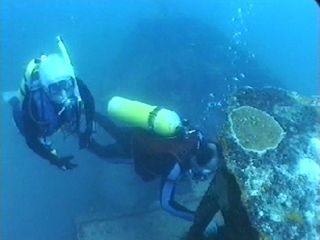
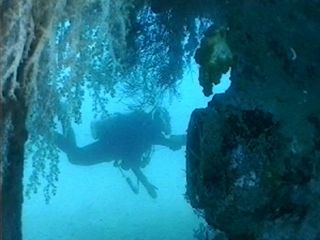
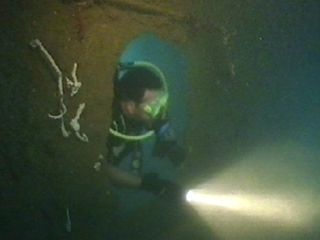
above the bow of the Henry Leith | The prop shaft hole of the Henry Leith | Eddy Labour goes through a hatchway |
As you swim along the deck or sides you will see that there are some extremely nice soft corals, sea whips, gorgonias, sponges and anemones all over the deck and hull. As well, the fishlife is quite good, with numerous firefish, coral trout, trevally, wrasses and triggerfish swimming in, over and around the wreck. At the stern, there are some excellent hard corals (only small) but the smaller fishlife is really prolific.
Under the stern you will see the rudder and the prop shaft hole. There is no prop, it was obviously removed prior to scuttling.
From here you can explore the inside of the wreck. There is a lot to see on the wreck, the holds and engine room. Since I am writing this many years after the event, I cannot remember the exact details of the inside, but you can enter the engine room from a number of spots, including the holds, the upper deck and from inside the superstructure. I cannot even remember if the engine was still inside, although I assume that it was there. You can penetrate the wreck in safety, although commonsense must be used. A great second dive.
A Trotmans anchor from the Wybia (Henry Leith) can be seen at the Port Albert Maritime Museum in Gippsland, Victoria.
Reference:
| 



 v6.00.307 © 2003-2005


