Michael McFadyen's Scuba Diving - TSS Wandra
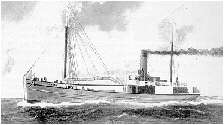 |
| A painting of the Wandra |
Although the TSS Wandra is an extremely small wreck, it is one of the most enjoyable wreck dives in NSW as it is shallow, allowing a long time to explore. However, its location makes it a little harder to access as it is a fair way from calm waters. More about this later.
The Wandra was a wooden coastal cargo ship constructed by Denis Sullivan at Coopernook in the Taree area of NSW. The keel was laid in September 1906 and its hull was built from locally obtained timber. The keel and keelsons were ironbark, the planking blackbutt and flooded gum and the frames hardwood. The deck was Oregon. It was launched on 1 June 1907 and incorrectly christened as the Wandy but correctly registered as theWandra.
The new ship was owned by Allen Taylor and Company, which started business in 1893 carrying timber from the North Coast to Sydney (the company was still operating in June 1984, but not with ships). The Wandra was 36 metres long, with a beam of just over 8 metres and displaced 164 tons. The small vessel had twin compound engines (20 and 10 inch diameter cylinders) which were powered from a single boiler. The engines were fitted by Messrs. Begg and Greig of Sydney after it was towed to Sydney by the tug Alice owned by J and A Brown. A speed of 9 knots was envisaged. It also had two masts and accommodation for the crew of 12.
 |
A photograph of the TSS Wandy being launched on 1 June 1907
Photo courtesy of Chris Borough |
In August 1907 the TSS Wandra took up service on the "Cape Hawke" trade. It seems to have replaced the SS Tuncurry as the Manning River Bar was now too shallow for the Tuncurry.
On 4 February 1913 the Wandra was coming down the Manning River when it hit bottom and damaged the starboard propellers, losing two blades. On 28 July 1913 the vessel was involved in the rescue of the dismasted schoonerTramp five miles south of Crowdy Head. She took her in tow and as there was a large sea at the Manning River bar, the tug John Gollan went out and took over the tow from the Wandra. She towed her inside, the tug and the dismasted vessel entering the river at 3:55 pm.
On 25 February 1915 she damaged two blades of her propellers in the Bellenger River while exiting the river for Port Stephens and Newcastle.
On 15 December 1915 at 2pm, the TSS Wandra left Moruya Heads with a cargo of timber for Sydney. She passed the Point Perpendicular Lighthouse (at the entrance to Jervis Bay) at 9.20pm with a moderate south-easterly winds and sea. One mile off Crocodile Head (a few kilometres to the north of the light), a wave came over the bow and then another. The hull's timbers came apart under the pressure of the waves and water flowed in and she listed to port (why do most ships in NSW list to port before sinking?).
The ship's pumps were started but made no difference. The Wandra was out of real control but Captain Reuben Lucey managed to steer her further along the coast and into the relative safety of The Drum and Drumsticks where the anchor was dropped.
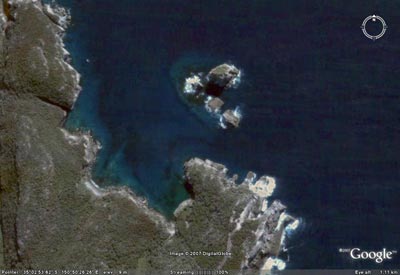 |  |
The Drum and Drumsticks
The Wandra is north-west of the
white water on the left of the island | South-eastern Mark |
The crew lowered one of the lifeboats and climbed aboard. As Captain Lucey entered the lifeboat, the Wandra sank. As they left the scene, the masts of the ship were sticking out of the water even though it was on the bottom. The 12 survivors (everyone on board) rowed to shore (probably a small protected inlet to the west-north-west) and then walked to Point Perpendicular where they arrived at 1.30am. The crew arrived in Nowra at 12:30 pm, having walked and ridden in a cart drawn by a horse.
On Friday 14 January 1916, Mr F R Strange advised in the Sydney Morning Herald that he "was selling by public auction at 28 Market Street, Sydney, at 11:30 am, the wreck of the steamer Wandra as she now lies at The Drumsticks, near Jervis Bay Heads, including a cargo of hardwood, consisting of hardwood sleepers". I do not know if he ended up finding a buyer.
The wreck of the TSS Wandra was discovered by John Harrington and Paul Jones in 1973 while searching for aquarium fish near the Drums and Drumstick.
The wreck of the Wandra does not cover a large area, but it makes up for it in quality. The remains lie at 26 metres on a sand bottom straight next to the rocky reef at GPS Reading of 35° 02.7021' S 150° 50.3485' E (using datum WGS84 as datum - see my GPS Page for more details). Run in on the mark above right till the reef appears. Anchor on the reef, you will only be a few metres from the wreck. See GPS and Marks Page for more details.
 |
A diagram of the TSS Wandra by John Riley
John Riley Memorial Collection, Heritage Branch, OEH |
A description of the wreck is as follows. From the south there is a small winch and to the east about five metres away is a bollard and another unknown item. These have kelp growing on the top. Some anchor chain can sometimes be seen above the sand but this can change as the sand moves about a fair bit.
There are some ribs of the hull or similar sticking out of the sand near here as well. About 10 metres north there is a large winch and 15 metres further north again there is the boiler, right up against the reef. This is quite large and worth examining. It has many things living in the pipes, including moasic eels and conger eels. You will probably be anchored near the boiler, so this is most likely where you start and end the dive.
 |  |
Kelly McFadyen and the props
Note engines in background | Kelly McFadyen and the engines of the Wandra |
Right next to the boiler are the engines. These twin cylinder engines sit upright, with the smaller cylinder facing the bow (south). They are tiny compared to most shipwreck engines you will ever see. I even think that they look "cute". A prop shaft runs from each engine to the north, with small propellers at the ends. These are mostly clear of the sand, but again, can sometimes be buried.
In front of the props are a small winch as well as a circular loop thing (I have no idea what this might be).
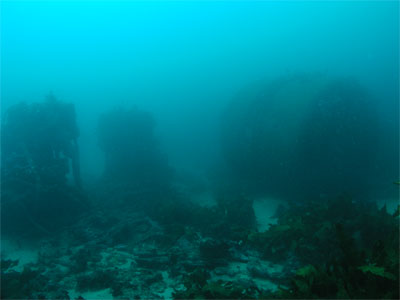 |  |
| The engines and boiler of the Wandra | Another shot of the engines and boiler of the Wandra |
 |  |
| One of the engines | Another shot of the boiler of the Wandra |
In between the prop shafts there are lots of things to see, including some timber pieces that were probably part of the hull and decking. You can also see the bolts that held her together. After big seas, you can see some of the timber cargo lying on the sand. The ship's telegraph was found by a local Jervis Bay diver and is now in his lounge room. It was buried under the sand.
The remaining cargo is rotting away, victim of time and marine animals.
An excellent dive, usually with calm seas and good visibility.
References:
Shipwrecks, Storms and Seamen by Max Gleeson
Scuba Action - Riley's Wrecks - article by John Riley, date unknown
Scuba Action - list of top NSW wrecks by John Riley, Sept/Oct 1986
Sydney Morning Herald 17 December 1915 and 14 January 1916
North Coast Run
Jervis Bay by Tom Byron
Lloyds Register 1910-11, 1913-14
Skindiving in Australia and the South Pacific Volume 14 No 3 June 1984
The Manning River Times and Advocate for the Northern Coast Districts of New South Wales - Wed 5 Jun 1907
The Manning River Times and Advocate for the Northern Coast Districts of New South Wales - Wed 19 Jun 1907
The Manning River Times and Advocate for the Northern Coast Districts of New South Wales - Sat 31 Aug 1907
The Sun - Wed 5 Feb 1913
The Sydney Morning Herald - Thu 26 Feb 1914
The Manning River Times and Advocate for the Northern Coast Districts of New South Wales - Sat 2 Aug 1913
Emails from Chris Borough dated 27 March 2023 | 



 v6.00.307 © 2003-2005


