|
Michael McFadyen's Scuba Diving - Church Grounds
Shellharbour is located just over 100 kilometres south of the centre of Sydney. This makes it within 90 minutes drive of most people in the metropolitan area, and much close for those of us who live south of the Harbour. There are a number of good shore dives (The Gutter, Bushrangers Bay and the Gravel Loader) here as well as many great boat dives. As close as this location is to Sydney, not many divers travel the short distance to dive Shellharbour except to do shore dives. It is almost unknown for people to go there for a weekend.
Well, the dive Club of which I am a member St George Scuba Club, ran many dive weekends to there over the period in the early 2000s. These were very well attended. During these trips, we explored the area a bit and found some great dive sites. Some of these are, of course, known to the local dive shops (as of early 2006 there were three, way too many for such a location - as I forecast at the time at least one would fail, in fact two did, as there was no way there was enough divers to support all three). The only shop left does not have a boat so you can only dive here via private boats.
Anyway, when we first started going there with our boats, we were shown a number of dive sites by one of our members. One of the ones I was told about was the Church Grounds but I did not actually get to dive it till 2026.
From Shell Cove Boat Ramp, head out almost north-east for about 2.25 kilometres to GPS Reading 34° 34' 29.946" S 150° 53' 21.509" E (using WGS84 datum - see my GPS Page for details). You will be almost east of the old ramp inside Shellharbour Harhour. The site gets its name from the church wo the east which used to be used to locate the site by lining up marks.
Check your depth sounder and you will see that the bottom on the reef is 321 to 23 metres and on the sand about 26 metres. Anchor on the reef near the sand edge, probably with sand to the south. The reef has a series of gutters that run north-west to south-east.
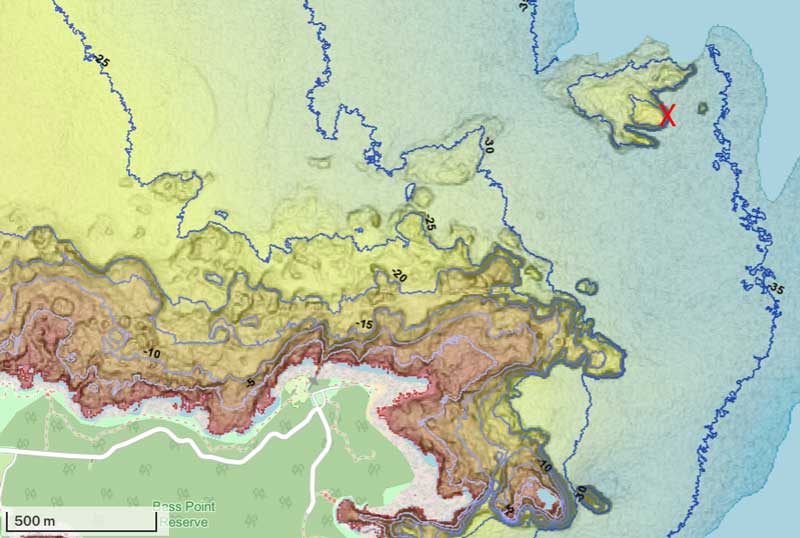 |
| The location of the dive site. Bass Point Reserve is at bottom left, Bushrangers Bay at very bottom. These are sea floor maps from NSW Government Seed website. |
In the area where the GPS reading will put you, you will find that you are near a sandy gutter that runs to the south-east near the anchor. You can follow the gutter in this direction on the southern side. There are some nice small overhangs and a gutter or two. After about 8 minutes you will see some larger boulders. When we dived here there were thousands of ladder-finned pomfrets and yellowtail in this area.
There are some larger cracks and overhangs here. If you go around the boulders to your right you will come to a larger crack or gutter which runs back to the north or so. At the end of this you will be in another gutter. Head back to the north-west for about 8 minutes and then go over the reef to your right towards the north-east. This comes up to 21 metres. After a short distance you should be back in the vicinity of the anchor.
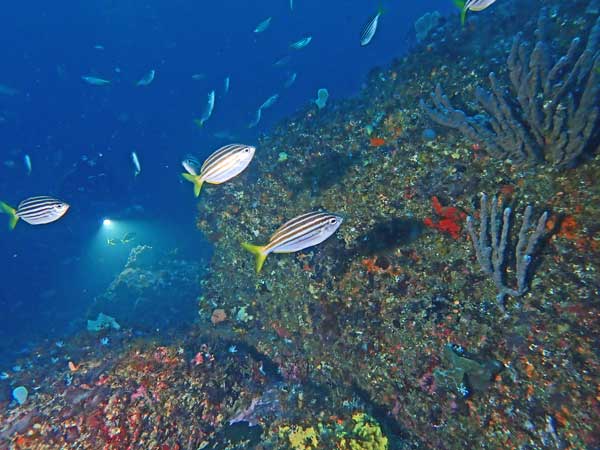 | 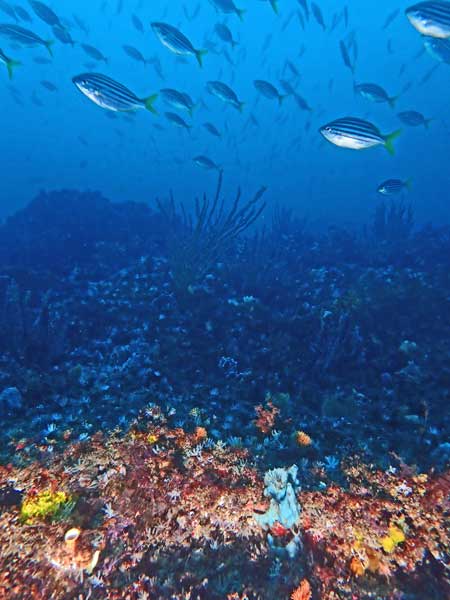 |
| Simon Graf and a section of the wall | Thousands of mado over the reef |
Once you are here, you can turn right and this time head down the left side of the gutter. This will turn to the north-east after about five minutes. Here I turned around anc came back on the top of the reef to near the anchor. There is a large piece of very thick rope, at least 50 mm thick, running all over the reef. If you follow it you will find it connects to a large chain and the other end to a series of four or five railway sleepers (or similar). I assume it was a mooring for a large vessel.
The wall has lots of sponges, sea squirts and other fixed marine life. There are a few tiny gorgonias along this section of wall.
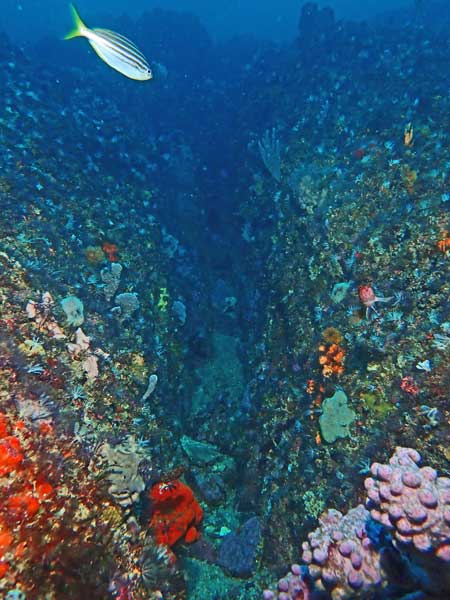 | 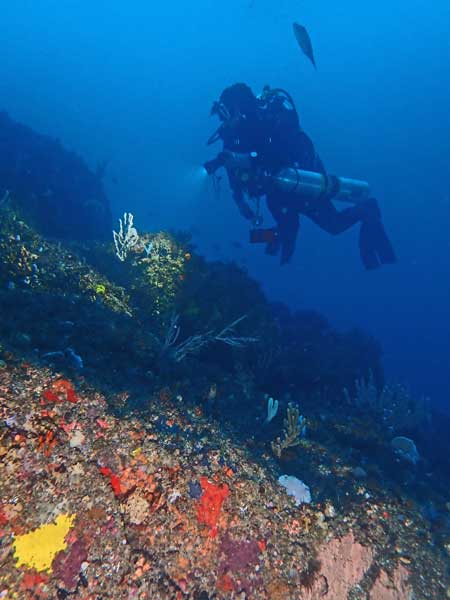 |
| A small crack in the reef | Simon over another section of the reef.
Note all photos dark due to a very heavy overcast |
After 7 minutes or so, turn around and come back to the anchor spot. If you are using air, continue past the anchor and the reef will turn to the north-west a little. The reef slopes down to your right, with the bottom composed of small boulders. Due to the depth, you will only get about 15 minutes before entering decompression if you stay close to the sand or about 20 minutes if you vary your depth.
On 32% nitrox, you should be able to get about 30 minutes on the bottom before reaching your no deco limit. Therefore you can go a little further to the south before turning and further to the north. You will also see s shear wall here past the boulders. Turn around and head back after a total of 22 minutes or so.
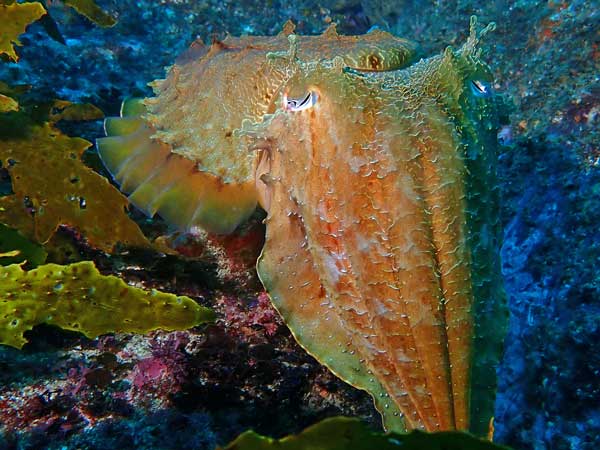 | 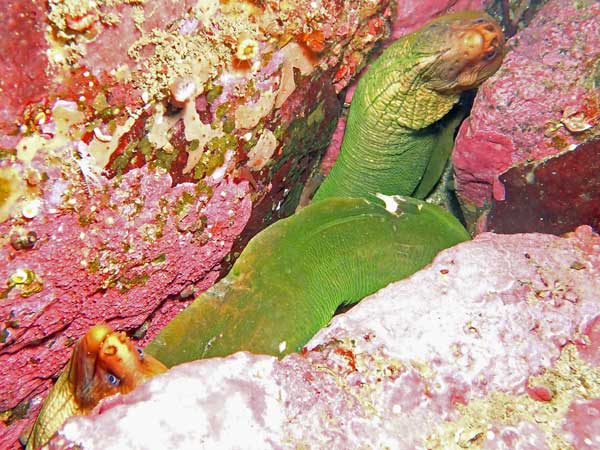 |
| A very large cuttlefish on the top of the wall | Two moray eels down deeper |
This site has lots of colourful fixed marine life but there are not that many fish around at times. I have seen a few Port Jackson sharks, some black reef leatherjackets, seapike, mado (one dive thousands of them), moray eels, large cuttlefish, yellowtail and one-spot pullers. There are also lots of nudibranches. There are also thousands (maybe millions) of tiny white featherstars (that is what I think they are) all over the reef. They are all about 15 mm or so in size, so I assume they only grow that big.
Once back near the anchor, spend the rest of your time in this area exploring. The top of the wall is essentially flat, but there are some small holes and gutters to look into. The top has kelp in some sections.
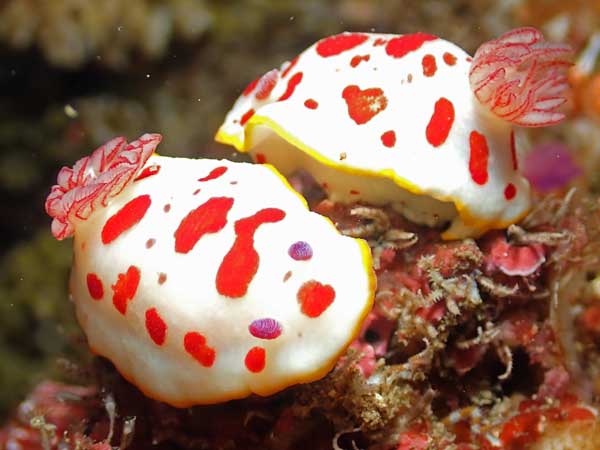 | 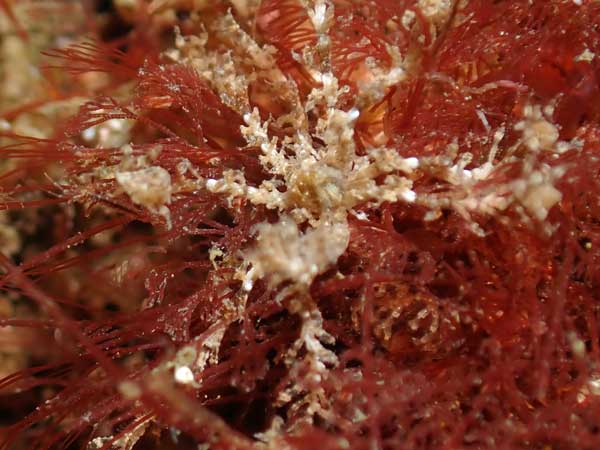 |
| Two mating nudibranchs | I think this is a tiny white featherstar, there are thousands at this site |
Despite the lack of fishlife, it is a really interesting dive. Of course, due to the depth, this is only a dive for the very experienced. I have had very good visibility here on most dives, up to 20 metres or so.
| 



 v6.00.307 © 2003-2005


